
Skip to content
madefrom.hk madefrom.hk madefrom.hk

多元內容出版平台,涵蓋漫畫、原創故事、文學改編、香港文化、歷史、科技及影音作品,連結本地與世界各地的故事。

madefrom.hk madefrom.hk madefrom.hk

多元內容出版平台,涵蓋漫畫、原創故事、文學改編、香港文化、歷史、科技及影音作品,連結本地與世界各地的故事。

  • English
    • Comics
      • Strange Tales
      • Myths of the Constellations
    • Games
      • Famicom Disk System
    • Column
      • Life & Technology
      • Toy Club
      • DAY
    • History
      • Old Newspaper Digests
      • History in 80 Seconds
    • Audiobooks
    • Adapted Stories
      • romance of the three kingdoms
      • hong kong places
      • dream of the red chamber
      • strange tales
      • The house on the borderland
      • usherhouse
      • Theblackcat
  • 繁體中文
    • 漫畫
      • 星座宮神話
      • 碧廬冤孽
      • 十三號的約定
    • 學習筆記
    • 專欄
      • 生活與科技
    • 歷史
      • 當年報章摘要
    • ACG
      • Winter 2026 Anime
      • Summer 2026 Anime
      • ACGHK
        • 2016
        • 2018
        • 2019
        • 2023
        • 2024
      • 創天綜合同人祭
        • 同人表演
      • 音樂
      • 電玩
        • 玩具資訊
        • 遊戲資訊
    • 原創小說
      • 不可思議故事
      • 十三號的約定
      • 星座宮神話
      • 香港山怪談
      • 香港都市靈異傳說
    • 旅行
      • Macau Travel
      • International Travel
      • 日本旅遊
      • Taiwan Travel
      • Thailand Travel
      • Hong Kong Travel
        • 土瓜灣
        • 舊建築
        • 街道
        • 單車
        • 文化
        • 交通
        • 香港書展
        • 表演
        • 廟宇
        • 教堂
        • 香港書展
        • 分享會
        • 紀念活動
        • 文化活動
        • 活動
        • 寵物
        • 巴士
        • 電車
        • 機場
        • 飲食
          • 上環
          • 中環
          • 筲箕灣
          • 西環
          • 天后
          • 旺角
          • 荔枝角
          • 佐敦道
          • 太子
          • 大角咀
          • 深水埗
          • 油麻地
          • 長沙灣
          • 黃大仙
          • 尖沙咀
          • 油塘
          • 葵芳
          • 屯門
          • 元朗
          • 上水
          • 粉嶺
          • 荃灣
          • 渡輪
    • 心理測驗
    • 節目重溫
      • 文化生活
      • 莎拉有約
      • 尾尾道來
  • 遊戲
    • SNK Neo Geo
    • PlayStation 2
    • Arcade
    • NEWS
  • Column
    • Knowledge Hub
      • 生活篇
      • 食品篇
      • 科技篇
      • 超市篇
    • Hong Kong Guide
    • Today in History
    • City Stories
    • Anime & Manga
    • Game Magazine
    • 遊戲誌
    • Language of Flowers
    • Street Notes
    • All Things
    • Music Memories
    • Chinese Idioms
    • Cantonese Sayings
    • Movie Magazine
  • History
    • 香港歷史
    • 世界名作家
    • World Biographies
  • Movies
    • USA
    • japan
    • Korea
    • Taiwan
    • HONGKONG
    • India
    • china
    • france
    • Tunisia
    • Germany
    • Jordan
    • Switzerland
    • sweden
    • Spain
    • Palestine
    • Norway
    • Argentina
    • Brazil
  • English
    • Comics
      • Strange Tales
      • Myths of the Constellations
    • Games
      • Famicom Disk System
    • Column
      • Life & Technology
      • Toy Club
      • DAY
    • History
      • Old Newspaper Digests
      • History in 80 Seconds
    • Audiobooks
    • Adapted Stories
      • romance of the three kingdoms
      • hong kong places
      • dream of the red chamber
      • strange tales
      • The house on the borderland
      • usherhouse
      • Theblackcat
  • 繁體中文
    • 漫畫
      • 星座宮神話
      • 碧廬冤孽
      • 十三號的約定
    • 學習筆記
    • 專欄
      • 生活與科技
    • 歷史
      • 當年報章摘要
    • ACG
      • Winter 2026 Anime
      • Summer 2026 Anime
      • ACGHK
        • 2016
        • 2018
        • 2019
        • 2023
        • 2024
      • 創天綜合同人祭
        • 同人表演
      • 音樂
      • 電玩
        • 玩具資訊
        • 遊戲資訊
    • 原創小說
      • 不可思議故事
      • 十三號的約定
      • 星座宮神話
      • 香港山怪談
      • 香港都市靈異傳說
    • 旅行
      • Macau Travel
      • International Travel
      • 日本旅遊
      • Taiwan Travel
      • Thailand Travel
      • Hong Kong Travel
        • 土瓜灣
        • 舊建築
        • 街道
        • 單車
        • 文化
        • 交通
        • 香港書展
        • 表演
        • 廟宇
        • 教堂
        • 香港書展
        • 分享會
        • 紀念活動
        • 文化活動
        • 活動
        • 寵物
        • 巴士
        • 電車
        • 機場
        • 飲食
          • 上環
          • 中環
          • 筲箕灣
          • 西環
          • 天后
          • 旺角
          • 荔枝角
          • 佐敦道
          • 太子
          • 大角咀
          • 深水埗
          • 油麻地
          • 長沙灣
          • 黃大仙
          • 尖沙咀
          • 油塘
          • 葵芳
          • 屯門
          • 元朗
          • 上水
          • 粉嶺
          • 荃灣
          • 渡輪
    • 心理測驗
    • 節目重溫
      • 文化生活
      • 莎拉有約
      • 尾尾道來
  • 遊戲
    • SNK Neo Geo
    • PlayStation 2
    • Arcade
    • NEWS
  • Column
    • Knowledge Hub
      • 生活篇
      • 食品篇
      • 科技篇
      • 超市篇
    • Hong Kong Guide
    • Today in History
    • City Stories
    • Anime & Manga
    • Game Magazine
    • 遊戲誌
    • Language of Flowers
    • Street Notes
    • All Things
    • Music Memories
    • Chinese Idioms
    • Cantonese Sayings
    • Movie Magazine
  • History
    • 香港歷史
    • 世界名作家
    • World Biographies
  • Movies
    • USA
    • japan
    • Korea
    • Taiwan
    • HONGKONG
    • India
    • china
    • france
    • Tunisia
    • Germany
    • Jordan
    • Switzerland
    • sweden
    • Spain
    • Palestine
    • Norway
    • Argentina
    • Brazil
Close

Search

Life and Technology Season 3 Computer Series | The Birth of Open Source: From GNU to a New Way of Building Computers | Madefrom.hk
EnglishLife & Technology

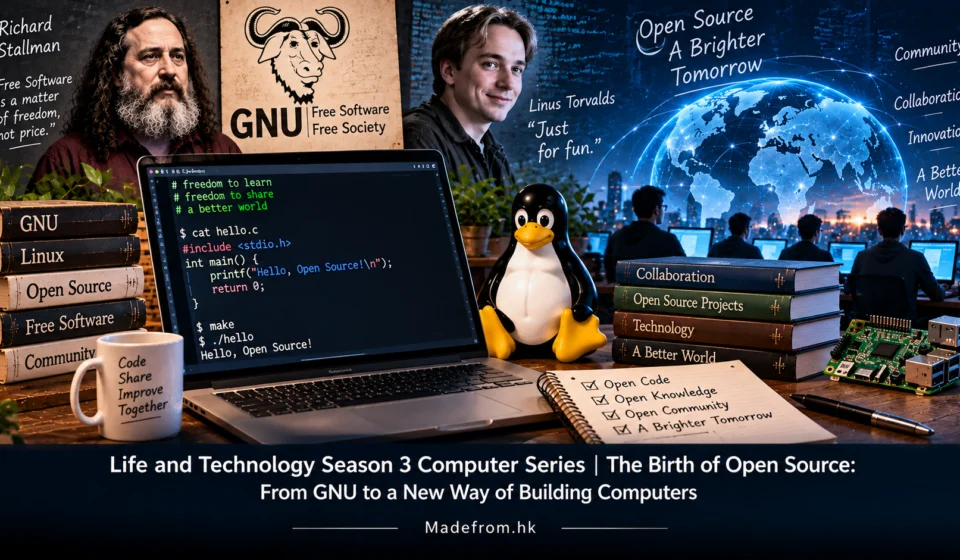
Life and Technology Season 3 Computer Series | The Birth of Open Source: From GNU to a New Way of Building Computers

2026-10-15

Open source software feels completely normal today, but the idea was once a radical challenge to the way computer software was produced and controlled. As software became increasingly commercial and restricted by licences, a different question emerged: what if users could study the code, change it, share it and improve it together? That idea helped lead to the GNU project, Linux and eventually the modern open-source movement.


The open-source software world that we know today did not appear overnight. Its roots can be traced back to an earlier computing culture in which programmers, universities and research laboratories commonly shared software and modified programs for their own needs. During the 1970s and 1980s, however, software increasingly became a commercial product. Source code was treated as valuable intellectual property, and users were often given software under restrictive licences without the freedom to study, modify or redistribute the underlying code. For some programmers, this represented more than a change in business practice. It meant that the cooperative culture of computing was disappearing. Richard Stallman, who worked at MIT’s Artificial Intelligence Laboratory, became one of the most influential figures in the response to this change. On 27 September 1983, he announced the GNU Project, proposing the development of a Unix-compatible operating system that users could freely use, study, modify and share. The name GNU stands for “GNU’s Not Unix”, a recursive acronym chosen to describe a system that would be technically compatible with Unix while taking a different approach to software freedom. An important point in this history is the meaning of the word “free”. Free Software was never simply about obtaining software without paying money. It was primarily about freedom: the freedom to run a programme, study its source code, modify it and redistribute the original or improved version. In other words, the question was not simply whether software cost nothing, but whether users had meaningful control over the technology they were using. The GNU Project therefore represented a much larger idea than the creation of another operating system. It was an attempt to rebuild a culture of cooperation around computer software. Building a complete Unix-like operating system was an enormous task. A modern operating system requires far more than a kernel. It needs compilers, editors, shells, libraries, system utilities, documentation and many other components. The GNU development effort officially began in 1984, while the Free Software Foundation was established in 1985 to support the wider free-software movement. By around 1990, GNU had developed or obtained most of the major components required for a Unix-like system, but one critical piece was still missing: the kernel. Then another story began in Finland. In 1991, Linus Torvalds started developing the Linux kernel. What began as a personal computer project soon attracted contributions from other programmers. Linux became free software in 1992, and developers began combining the Linux kernel with many of the tools already developed by the GNU Project. The resulting GNU/Linux system demonstrated something that would become fundamental to the open-source world: a complex computer system could be built through cooperation between people who did not necessarily work for the same company or even live in the same country. One programmer could work on the kernel, another could improve a compiler, another could fix a bug, someone else could write documentation, and another developer could package everything into a distribution. The development process itself became part of the technology. However, there is an important historical distinction between Free Software and the term Open Source. The free-software movement began in the 1980s, while the phrase “Open Source” was introduced later. In 1998, Netscape announced plans to release the source code of its browser, creating renewed mainstream interest in collaborative software development. On 3 February 1998, a strategy meeting was held in Palo Alto to promote the term “Open Source”, and the Open Source Initiative was formed later that year. The new terminology helped present collaborative development not only as a question of user freedom, but also as a practical and effective way of producing software. Open source, however, does not simply mean putting source code on a website. The Open Source Definition establishes requirements concerning redistribution, access to source code and the ability to modify and distribute software under appropriate licensing conditions. This distinction is important because open source is ultimately about a method of development as well as a type of software licence. Instead of every technical decision being controlled entirely inside one company, an open-source project can invite developers around the world to inspect the code, identify problems, test changes, suggest improvements and contribute new features. Over time, this model expanded far beyond operating systems. Open-source principles became important in web servers, programming languages, databases, browsers, development frameworks, cloud infrastructure and eventually artificial intelligence. Many technologies that people use every day contain open-source components, even when the final product itself is commercial. This means that open source did not simply replace proprietary software. Instead, it created another major path for technological development. Commercial companies can build valuable products around open-source technologies, while open communities can continue developing the underlying tools. The result is a technology ecosystem in which commercial development and collaborative development can exist side by side. Looking back from today’s world, the journey from GNU to Linux and then to the formal rise of the Open Source movement represents a major change in the history of computing. The most important change was not the creation of a particular programme. It was the question of who could participate in designing computer technology. A computer system no longer had to be something created entirely by a large company and simply accepted by its users. It could also become a shared technical project, improved by people across countries and organisations. From operating systems and browsers to development tools and artificial intelligence frameworks, modern computing continues to carry the influence of that idea. Open source therefore became more than a licensing model. It became a different way of imagining how technology could be designed, built, improved and shared.


Open source was not born on a single day. It developed through the free-software movement, GNU, Linux and the formal Open Source movement of 1998. Together, these developments helped transform software from something controlled mainly behind closed doors into technology that could be studied, modified and improved collaboratively across the world.

Views: 22
延伸閱讀
生活與科技 第18集 為什麼科技總有 Beta 版本:當產品還在學習世界 | Why Technology Always Has a Beta Version: When Products Learn from the Real World
Beta版本的存在,反映了科技產品從設計到實際應用過程中的一個重要階段。無論在設計時如何精密規劃,真實世界的使用情境總是充滿變數,這使得…
生活與科技 第29集 如果機器完成所有工作:人類還會成為什麼? | If Machines Did All the Work: What Would Humans Become in a Fully Automated World?
在一個完全自動化的世界裡,機器承擔了所有的勞動,從建造城市到管理醫療、物流與生產,甚至連治理都由人工智慧進行。這樣的社會運作精密而高效,…
生活與科技 第32集 當演算法開始同化人類:科技不再只是工具 | When Algorithms Begin to Assimilate Humans: Technology Is No Longer Just a Tool
演算法的發展在近年來取得了顯著的進步,從早期的簡單工具演變為如今深度影響人類生活的技術。過去,我們提到演算法,通常聯想到效率的提升,例如…
生活與科技 第7集 – 為系統而活:當人生開始配合流程 | Living for the System: When Life Begins to Follow Processes Instead of Meaning
最初,系統的出現,是為了幫助人。 它們處理重複的工作。 減少摩擦。 減輕不必要的負擔。 它們只是工具—— 安靜、隱形、可選擇。 但慢慢地…

Tags:

Building ComputersGNULife and TechnologyNew Way
Author

admin

Follow Me
Other Articles
Previous

The Adventurous Soul (1927): A Silent Drama of Identity, the Sea and Unexpected Adventure  | USA Film | Trailer

Next

Myths of the Constellations | Episode 11 | Fire Without Direction |English Comic Edition 

  • Patreon
  • Facebook
  • Instagram
  • YouTube
  • Bluesky
  • Tumblr
  • LinkedIn

Register|Lost your password?

  • Terms of Service
  • Privacy Policy
  • Contact
  • About Us
  • Register
  • Login
  • Password Reset
  • Advertising
  • Column Sponsorship
  • plus member

Content & Corrections

This website covers films, animation, games, cultural columns, and other related content and information. Our information is primarily based on publicly available sources, official announcements, and editorial research. Content may be revised or updated when new information becomes available.
If you notice any errors, believe that information needs to be corrected, or have updated official information that may be added, please contact us by email:
📧 [email protected]
We will review the information and make updates as soon as possible after verification.
Thank you for your help and understanding.

  • 《莎拉有約》第十九集 |從 IT 專才到自然療法師:一場由健康開始的人生轉型 主持:莎拉 嘉賓:人體能量分析師 ~天傑
  • 《莎拉有約》第十八集|不離不棄的保險服務:從孤兒單、理賠個案到客戶信任 主持:莎拉 嘉賓:林碧華小姐
  • 《莎拉有約》第十七集|認識 DISC 性格與女性心理:從性格分析到「思覺敏感」主持 莎拉 嘉賓 Points Of You® 認證教練及培訓師 GiGi
  • Life and Technology Season 3 Computer Series | The Birth of AI: When Computers Began to Explore Human Intelligence
  • 《莎拉有約》第十六集|陪伴孩子成長:面對反叛期、情緒與親子溝通 | 主持 : 莎拉 嘉賓 : Points Of You® 認證教練及培訓師 GiGi

ACG HK anime Chinese Mythology Dream of the Red Chamber Hong Kong History On This Day Romance of the Three Kingdoms Silent film world history 三國演義 世界歷史 中國古典小說 中國神話 今日歷史 劉備 動畫 動畫電影 古典文學 台灣旅遊 專欄 小說連載 山海經 廣東話歇後語 影評 恐怖電影 推薦 日本動畫 日本電影 曹操 林黛玉 歷史上的今天 澳門 紅樓夢 經典電影 美國電影 聊齋志異 賈寶玉 電影 電影劇情介紹 飲食 香港文化 香港旅遊 香港歷史 香港都市傳說 香港電影

Copyright 2021 - 2026 — 0studiohk.com | madefrom.hk. All rights reserved.