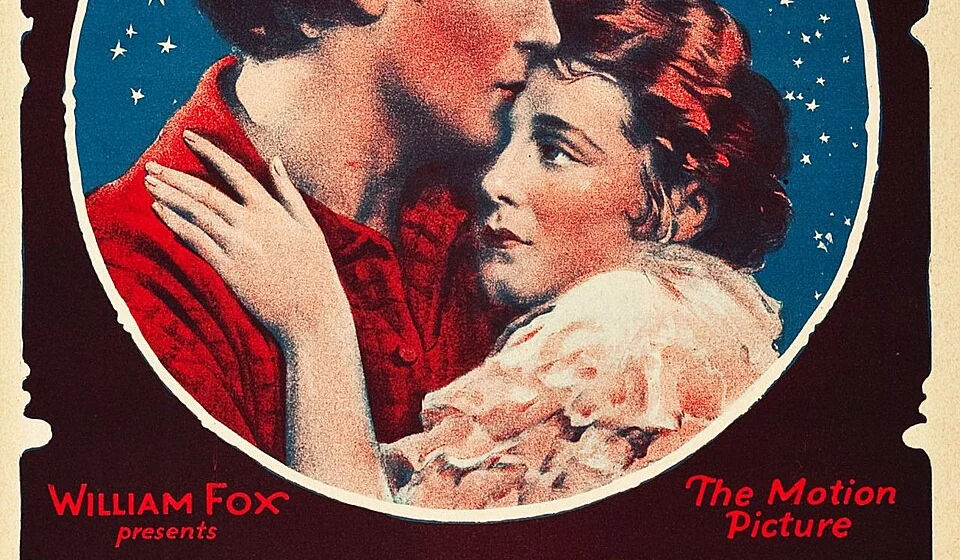
7th Heaven follows two lonely people living on the margins of Paris whose unexpected meeting develops into a powerful love story. Against poverty, social hardship and the approaching First World War, their relationship becomes a quiet search for dignity, hope and a better life.
7th Heaven is a 1927 American romantic drama directed by Frank Borzage and starring Janet Gaynor as Diane and Charles Farrell as Chico. Based on Austin Strong’s stage play, the film places its characters in Paris during the years leading up to the First World War and follows two people whose lives begin at very different points but are both marked by hardship and isolation. Chico is a sewer worker who has little status or money, yet he refuses to accept that his life must remain underground. He dreams of becoming a street cleaner, a modest ambition that nevertheless represents something much larger to him: the chance to work in the open air, see the sky and move towards a more respectable life. Diane, meanwhile, is trapped in an abusive and unstable home. She is mistreated by her older sister Nana and has been pushed into a life that leaves her vulnerable to poverty, violence and social judgement. Their paths cross when Chico intervenes to protect Diane from her sister. When the police arrive, Chico suddenly claims that Diane is his wife, creating a story that is initially intended only to save her from arrest. The lie changes both of their lives. Diane is allowed to remain with Chico, and the two begin sharing his modest home. What begins as an arrangement becomes an unexpected relationship. At first, Chico keeps an emotional distance from Diane. He sees himself as someone who has simply done the right thing in a difficult situation, while Diane has so little confidence in herself that genuine affection seems almost impossible for her to believe. Their relationship gradually changes through everyday moments rather than grand declarations. They begin to understand one another, and the false marriage slowly develops into genuine love. The film’s title carries a symbolic meaning throughout the story. Chico’s life underground and Diane’s troubled existence both place them metaphorically at the bottom of society. Their small home high above the streets becomes a private world separated from the difficulties surrounding them. The journey from the sewer towards the sky therefore becomes a visual and emotional metaphor for hope, dignity and personal transformation. The idea of climbing upwards is not simply about wealth or social success. Instead, it suggests that people can rise emotionally and spiritually even when their circumstances remain difficult. Their happiness, however, cannot remain untouched by history. As the First World War approaches, the private world that Chico and Diane have created is threatened by events far beyond their control. Chico is eventually called away to serve in the war, turning their love story into one shaped by separation, uncertainty and fear. The war does not replace the romance as the central subject of the film; rather, it tests the strength of the bond that the two characters have built. Borzage’s direction is particularly suited to the silent-film form because emotion is carried through faces, gestures, movement, visual composition and intertitles instead of spoken dialogue. Gaynor’s performance presents Diane as vulnerable but increasingly confident, while Farrell’s Chico develops from a guarded and somewhat cynical man into someone capable of genuine tenderness. Their chemistry became one of the defining features of the film, and the two actors would eventually appear together in many more productions. Although 7th Heaven is often described as a romance, its themes extend beyond love. The film explores poverty, class, social exclusion, personal dignity, courage and the human desire to escape circumstances that seem permanent. Its romantic story is therefore closely connected to the characters’ search for a better existence. Neither Chico nor Diane begins the story with power or privilege. What they possess is the possibility of changing one another’s lives. This makes the film characteristic of Borzage’s romantic cinema, in which love can become a force capable of giving ordinary people a sense of meaning in an uncertain world. The film was also significant in the development of Fox Film Corporation and became one of the major successes of its period. At the first Academy Awards, it received nominations including Outstanding Picture, while Borzage won Best Director, Gaynor won Best Actress and Benjamin Glazer won for Adapted Screenplay. Gaynor’s award also recognised her performances in Sunrise: A Song of Two Humans and Street Angel, making her the first recipient of the Academy Award for Best Actress. Although originally released as a silent film, 7th Heaven was later reissued with a synchronized Movietone musical score and sound effects, while still relying on English intertitles rather than audible dialogue. The film was remade in 1937 with James Stewart and Simone Simon, but the 1927 production remains closely associated with the silent-era performances of Gaynor and Farrell. Nearly a century later, 7th Heaven remains an important example of how silent cinema could communicate emotional intensity without conventional spoken dialogue. Its central image of moving from darkness towards the sky gives the romance a broader meaning: love becomes a way for two isolated people to imagine that their lives can be different from what society has told them they must be.
Film Information
Frank Borzage
Romantic Drama、Silent Film、Melodrama
YEAR:1927
Janet Gaynor|Diane
Charles Farrell|Chico
Ben Bard|Colonel Brissac
Gladys Brockwell|Nana
David Butler|Gobin
7th Heaven combines romance, social hardship and hope through the visual language of silent cinema. Its contrast between the underground world and the open sky gives the story a strong symbolic structure, while Gaynor and Farrell communicate the growing intimacy between their characters through expression, movement and gesture rather than conventional dialogue.