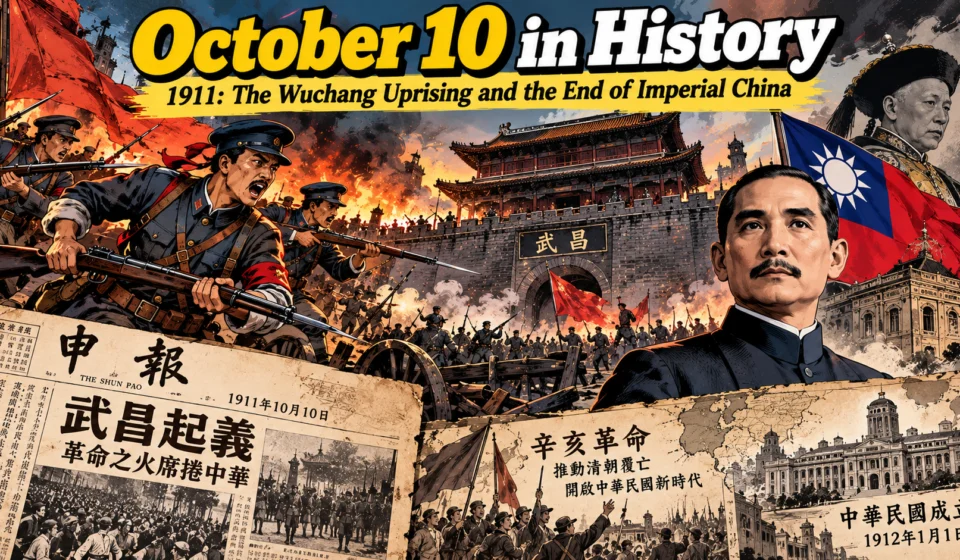
1. October 10, 1911: The Uprising Begins in Wuchang
On the evening of October 10, 1911, an armed uprising broke out in Wuchang, Hubei Province, China. Revolutionary members of the Hubei New Army rose against the Qing government and moved quickly to seize important military and administrative positions.
Known as the Wuchang Uprising, the event is generally regarded as the beginning of the Xinhai Revolution. It was more than a local military revolt: it triggered a wider political transformation that ultimately brought down the Qing dynasty and ended China’s long-standing imperial system.
By this time, the Qing government was facing multiple pressures, including disputes over political reform, social dissatisfaction, questions of national identity, and growing distrust between local communities and the central government. Revolutionary ideas were also spreading among students, intellectuals, soldiers, and other groups.
2. Why Did the Revolution Break Out?
From the late nineteenth century into the early twentieth century, the Qing dynasty faced wars, diplomatic crises, and repeated attempts at reform. The government introduced new policies and military reforms, but these measures did not resolve widespread dissatisfaction.
In 1911, the Qing government’s railway nationalization policy provoked strong opposition, particularly in Sichuan. Railways represented more than transportation: they involved local investment, commercial interests, and political authority. The dispute intensified tensions between the central government and local society.
In Hubei, revolutionary organizations had already built connections with members of the New Army and were preparing an uprising. On October 9, an accidental explosion at a revolutionary site in Hankou exposed information about the movement. Qing authorities began arresting suspected revolutionaries.
Facing the threat of arrest, revolutionary soldiers in Wuchang decided to act earlier than planned. The uprising began on the evening of October 10.
3. How Did the Uprising Become a Nationwide Revolution?
The insurgents quickly seized important positions in Wuchang. By the following day, revolutionary forces had taken control of the city and established a military government in Hubei.
As news spread, province after province declared its independence from Qing rule. The revolutionary movement expanded, and the dynasty’s authority began to collapse.
The Wuchang Uprising was not the achievement of a single leader. It involved revolutionary organizations, New Army soldiers, local political forces, and a wider set of social and political tensions. Its rapid expansion reflected both the Qing government’s growing crisis and differing expectations for reform and political change across the country.
Sun Yat-sen was a major figure in the revolutionary movement, but he was not in Wuchang when the uprising began. This underlines that the Xinhai Revolution was not driven by one individual alone; it emerged from the combined efforts of organizations and groups across different regions.
4. The Fall of the Qing Dynasty and the Founding of the Republic
After the uprising, revolutionary activity spread rapidly. In December 1911, revolutionary forces organized a provisional government in Nanjing.
On January 1, 1912, the provisional government of the Republic of China was established, with Sun Yat-sen serving as provisional president. On February 12, 1912, the Qing emperor Puyi abdicated, bringing the dynasty to an official end.
However, the end of imperial rule did not immediately produce stable democratic government. The new republic faced fragmented military power, competing regional interests, economic and social challenges, and conflicts among political groups. China subsequently experienced warlord conflict, political upheaval, and prolonged warfare.
The Xinhai Revolution was therefore both a historic turning point and the beginning of another complicated chapter.
5. Why Is October 10 Known as Double Ten Day?
Because the Wuchang Uprising began on October 10, the date became an important anniversary in the history of the Republic of China. It is commonly known as Double Ten Day or Double Tenth National Day.
In Taiwan, October 10 is observed as the National Day of the Republic of China, commemorating the 1911 uprising and the revolutionary history associated with it. The date also has historical significance for different Chinese communities, although interpretations of the Xinhai Revolution, the founding of the republic, and their legacy vary.
Historically, one of the uprising’s most important consequences was its role in accelerating the collapse of Qing rule and the establishment of a republic.
6. What Can We Learn from This Turning Point?
The Wuchang Uprising reminds us that major historical transformations rarely emerge without warning. They often follow years of political tensions, social change, and unresolved institutional problems.
When government reforms fail to meet public expectations, local interests clash with central decisions, and new political ideas gain support, established systems can face profound challenges.
Yet replacing an old system is only the first step. Building effective institutions, maintaining social stability, balancing competing interests, and meeting people’s political expectations can prove far more difficult.
October 10 in History, Wuchang Uprising, Xinhai Revolution, Qing Dynasty, End of Imperial China, Republic of China, Double Ten Day, Modern Chinese History, Revolution, Historical Review