
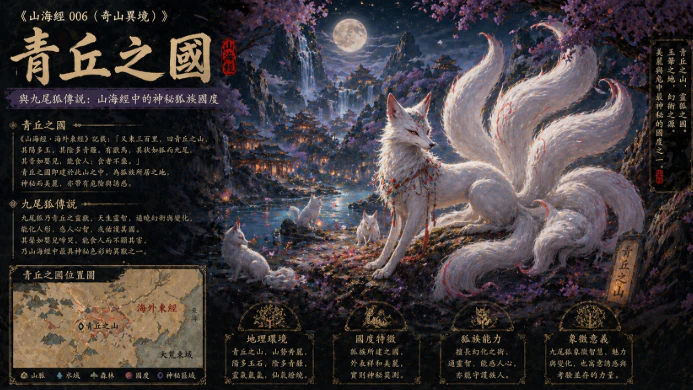
《山海經 006 (奇山異境)》青丘之國與九尾狐傳說:山海經中的神秘狐族國度解析Qingqiu Kingdom Explained: The Mythical Land of the Nine-Tailed Fox in Shan Hai Jing

青丘之國,是《山海經》中最具神秘色彩的國度之一,以九尾狐聞名。這種靈獸既象徵祥瑞,也隱含誘惑與變化之意,在不同時代被賦予多重文化解讀。青丘不只是地理存在,更是一個介於人與妖之間的異界。本文將探索青丘與九尾狐的神話來源、象徵意義,以及其如何影響後世文學與文化想像。
Qingqiu is one of the most enigmatic lands in Shan Hai Jing, famed for its nine-tailed foxes. These mythical creatures symbolize both auspicious power and seductive transformation, taking on layered meanings across different eras. More than a physical place, Qingqiu represents a liminal realm between humans and spirits. This article explores its origins, symbolism, and lasting cultural influence.
在《山海經》的眾多國度之中,青丘之國顯得格外神秘,它位於海外之地,被描述為一個盛產九尾狐的地方。九尾狐在古代中國神話中並非單一形象,它既可被視為祥瑞之獸,也可能象徵妖魅與誘惑,這種雙重性使青丘之國成為一個充滿張力的存在。據記載,九尾狐形似普通狐狸,但擁有九條尾巴,聲音如嬰兒啼哭,食其肉可避邪不惑,這樣的描述既帶有神異色彩,也暗示其與人類世界的密切關聯。青丘之國的「青」,常被解讀為東方或春天的象徵,代表生機與變化,而「丘」則意味著高地或聚集之所,因此青丘可被理解為一個充滿靈氣與轉化力量的地方。在這個國度中,九尾狐不僅是動物,更是一種介於自然與靈界之間的存在,它們能夠變化形態,甚至化為人形,這種能力在後世文學中被不斷強化,逐漸演變為具有情感與意志的角色。與其他神話地點不同,青丘之國並沒有明確的災難或毀滅敘事,它更像是一個平行於人間的世界,一個既吸引又危險的邊界空間。在文化層面上,九尾狐的形象經歷了顯著變化,從《山海經》中帶有神聖與中性的靈獸,逐漸轉變為後世志怪小說與戲曲中的妖狐,甚至成為誘惑與情慾的象徵,這種轉變反映了社會對女性、慾望與異類的複雜態度。青丘之國因此不僅是一個神話地名,更是一種文化投射,它承載了人們對未知、誘惑與變化的想像。在現代視角下,青丘可以被理解為一種「異界原型」,它代表著人類對於另一種存在形式的想像,一種不受現實規則限制的世界。九尾狐則象徵著身份的流動性與界線的模糊,它既可以是祝福,也可能是危險,這種不確定性正是其魅力所在。透過青丘之國的故事,我們得以窺見古人如何用神話來表達對世界多樣性的理解,以及對未知力量的敬畏與好奇。
English Version
Among the many lands described in Shan Hai Jing, Qingqiu stands out as a realm of mystery and transformation. Located in distant territories beyond the familiar world, it is known as the homeland of the nine-tailed fox, a creature that embodies both auspicious power and dangerous allure. Unlike a simple mythical animal, the nine-tailed fox represents a complex symbolic figure that evolves across time. In early texts, it is described as resembling a fox with nine tails and a voice like that of a crying infant, and consuming its flesh is said to grant protection from evil. Such descriptions suggest a being that exists at the boundary between the natural and supernatural worlds. The name Qingqiu itself carries layered meanings: “Qing” often signifies the east or the vitality of spring, while “Qiu” refers to a mound or gathering place, together evoking an environment rich in spiritual energy and transformation. In this realm, the nine-tailed fox is not merely an animal but a liminal entity capable of shifting forms, including taking on human appearance. This transformative ability becomes increasingly emphasized in later literature, where fox spirits develop personalities, emotions, and complex relationships with humans. Unlike myths centered on catastrophe, Qingqiu does not represent destruction but rather coexistence and ambiguity. It is a parallel world that both attracts and unsettles, a space where boundaries blur. Over time, the cultural image of the nine-tailed fox undergoes significant reinterpretation. From a neutral or even sacred creature in early mythology, it gradually becomes associated with seduction, illusion, and moral ambiguity in later stories. This shift reflects broader societal attitudes toward desire, femininity, and the unknown. Qingqiu, therefore, is not just a mythological location but a symbolic landscape shaped by human imagination and cultural values. In a modern context, it can be understood as an archetype of the “other world,” representing alternative modes of existence beyond rigid structures of reality. The nine-tailed fox, with its fluid identity, challenges fixed definitions and invites reflection on transformation and duality. Through the myth of Qingqiu, we gain insight into how ancient narratives encoded both fascination and caution toward forces that lie beyond human control.