史蒂芬·霍金與英國:探索黑洞與宇宙起源的天才物理學家 | Stephen Hawking and Britain: The Physicist Who Explored Black Holes and the Origins of the Universe | 世界名人錄
史蒂芬·霍金是近代最具影響力的理論物理學家之一,他以黑洞理論與宇宙學研究改變人類對宇宙的理解,即使身患重病,仍以驚人意志推動科學探索與知識傳播。
Stephen Hawking transformed modern cosmology through his groundbreaking work on black holes and the origins of the universe, becoming a global symbol of scientific brilliance, perseverance, and human curiosity.
中文版本
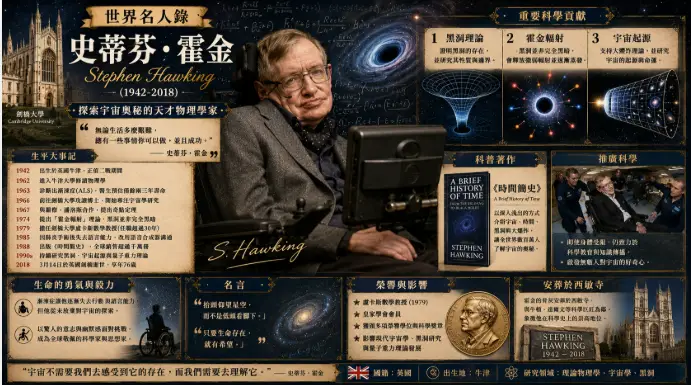
史蒂芬·霍金出生於1942年的英國牛津,當時正值第二次世界大戰期間。由於倫敦受到德軍轟炸,他的父母暫時搬到相對安全的牛津生活。霍金成長於知識氣息濃厚的家庭,父親是醫學研究人員,母親則熱愛教育與閱讀。從小的霍金對機械、數學與宇宙充滿好奇,他經常拆解物品研究運作原理,也喜歡與朋友討論科學問題。雖然他童年成績並非始終名列前茅,但身邊的人很早便察覺他擁有極高智力與獨特思考能力。年輕時的霍金進入牛津大學主修物理,之後前往劍橋大學研究宇宙學。二十世紀中葉的物理學正進入革命性時代,愛因斯坦的相對論與量子力學已徹底改變科學界對宇宙的理解,而宇宙起源與黑洞問題更成為理論物理的重要前沿。霍金深受這些議題吸引,希望透過數學與理論模型理解宇宙本質。然而,就在他二十出頭時,人生卻出現巨大轉折。1963年,霍金被診斷罹患肌萎縮性脊髓側索硬化症,也就是漸凍症。醫生當時預估他只能再活兩三年。這種疾病會逐漸癱瘓肌肉,最終導致患者失去行動與語言能力。對一名年輕科學家而言,這幾乎等同宣判未來終結。霍金在最初曾陷入低潮與絕望,但後來逐漸重新振作。他決定把有限生命投入科學研究,並在未婚妻珍的支持下持續完成學業。這段經歷不僅改變他的人生觀,也塑造出他後來堅韌而幽默的性格。1960年代後期,霍金開始與數學家羅傑·潘洛斯合作研究廣義相對論與奇點問題。他們利用數學證明指出,如果愛因斯坦理論成立,那麼宇宙很可能源自一個密度無限大的奇點,也就是後來大爆炸理論的重要基礎之一。這些研究讓霍金迅速成為宇宙學界備受矚目的年輕學者。1970年代,霍金進一步將量子力學與黑洞理論結合,提出改變現代物理學的重要概念——「霍金輻射」。傳統觀點認為黑洞具有極強引力,任何物質與光線都無法逃脫。然而霍金指出,若考慮量子效應,黑洞其實會緩慢釋放能量,最終甚至可能蒸發消失。這項理論震撼整個科學界,因為它首次將相對論、量子力學與熱力學聯繫在一起,也成為追求「萬有理論」的重要方向之一。霍金的研究大幅提升人類對黑洞與宇宙結構的理解,也讓他成為當代最著名理論物理學家之一。隨著病情惡化,霍金逐漸失去行動與說話能力。1985年一次肺炎手術後,他無法再以自然聲音說話,之後主要依靠語音合成器與輪椅溝通。然而,身體限制並未阻止他繼續研究與公開演講。他獨特的電子聲音後來甚至成為全球辨識度極高的象徵。1988年,霍金出版《時間簡史》,以通俗方式介紹宇宙、黑洞與時間概念。這本書意外成為全球暢銷科學著作,讓無數普通讀者首次接觸深奧宇宙學知識,也使霍金成為世界級科學明星。他不只在學術界具有影響力,也成為流行文化與大眾科學的重要代表人物。霍金晚年仍持續參與宇宙學研究,並討論人工智慧、外星生命與人類未來等議題。他認為人類應持續探索宇宙,並警告全球暖化、核戰與科技失控可能帶來危機。儘管長期受疾病折磨,他始終保持幽默感與對知識的熱情。2018年,史蒂芬·霍金於英國劍橋逝世,享年76歲。他的去世震動全球科學界與媒體。後來他的骨灰安葬於西敏寺,位於牛頓與達爾文墓旁,象徵他在科學史上的崇高地位。今日,霍金被普遍視為二十世紀末與二十一世紀初最具代表性的科學家之一。他不僅推動黑洞與宇宙學研究,更以自身生命故事鼓舞無數人。歷史學家與科學界普遍認為,史蒂芬·霍金象徵人類在面對身體限制與宇宙未知時,依然能透過智慧與意志持續探索真理。
English Version
Stephen Hawking was born in Oxford, England, in 1942 during the turmoil of the Second World War. His parents had temporarily relocated from London to avoid the heavy bombing raids affecting the capital. Raised in an intellectually curious family, Hawking grew up surrounded by books, academic discussion, and scientific thinking. His father worked in medical research, while his mother valued education and independent thought. From an early age, Hawking displayed a fascination with machines, mathematics, and the mysteries of the universe. Friends and teachers noticed his unusual intelligence, even though his school grades were not always exceptional. He enjoyed building models, experimenting with electronics, and debating scientific ideas with classmates. Hawking later studied physics at the University of Oxford before continuing graduate work in cosmology at Cambridge University. At the time, physics was undergoing a dramatic transformation as scientists attempted to unite Einstein’s theory of relativity with the strange laws of quantum mechanics. Questions about black holes, gravity, and the origin of the universe stood at the center of theoretical research, and Hawking quickly became captivated by these mysteries. However, his life changed dramatically while still in his early twenties. In 1963, Hawking was diagnosed with amyotrophic lateral sclerosis, commonly known as ALS or motor neurone disease. Doctors predicted he might survive only a few more years. The illness gradually destroys muscle control, eventually affecting movement, speech, and nearly all physical functions. For a young scientist at the beginning of his career, the diagnosis appeared devastating. Hawking initially struggled with despair, but he later found renewed motivation through his engagement to Jane Wilde and his determination to continue scientific work despite his condition. Rather than abandoning his ambitions, he devoted himself even more intensely to understanding the universe. During the late 1960s, Hawking collaborated with mathematician Roger Penrose on research involving general relativity and gravitational singularities. Together, they demonstrated mathematically that if Einstein’s equations were correct, the universe itself must have originated from an extremely dense singularity, providing crucial support for Big Bang cosmology. These discoveries established Hawking as one of the brightest young theorists in modern physics. In the 1970s, Hawking achieved the work that made him internationally famous. Combining principles from quantum mechanics with the physics of black holes, he proposed that black holes were not entirely black after all. According to Hawking’s theory, quantum effects near the edge of a black hole could cause it to emit tiny amounts of radiation, now known as Hawking radiation. Over immense periods of time, black holes could slowly lose energy and eventually evaporate. This idea shocked the scientific community because it connected relativity, thermodynamics, and quantum theory in an entirely new way. Hawking radiation became one of the most important theoretical breakthroughs in modern physics and remains central to ongoing efforts to develop a unified theory of the universe. As his illness progressed, Hawking gradually lost the ability to walk, write, and speak naturally. Following a serious illness in 1985, he underwent surgery that permanently removed his natural voice. He thereafter communicated using a speech synthesizer connected to a computer system, eventually controlling it with small facial movements. Despite these enormous physical challenges, Hawking continued lecturing, writing, and conducting research. His computerized voice became instantly recognizable around the world and symbolized his extraordinary perseverance. In 1988, Hawking published “A Brief History of Time,” a popular science book explaining black holes, cosmology, and the nature of time in language accessible to ordinary readers. The book unexpectedly became an international bestseller and introduced millions of people to advanced physics concepts for the first time. Hawking soon became not only a leading scientist but also a global cultural figure representing curiosity, intelligence, and resilience. Throughout his later years, Hawking continued exploring questions involving black holes, the multiverse, artificial intelligence, extraterrestrial life, and humanity’s long-term survival. He frequently warned about potential threats such as climate change, nuclear war, and uncontrolled technology while encouraging humanity to continue exploring space and expanding scientific knowledge. Even while living with severe physical limitations, he maintained a sharp sense of humor and remained deeply committed to public education and scientific discovery. Stephen Hawking died in Cambridge in 2018 at the age of seventy-six. His death was mourned across the world by scientists, political leaders, students, and admirers far beyond the scientific community. His ashes were later interred in Westminster Abbey near the graves of Isaac Newton and Charles Darwin, reflecting his extraordinary place within scientific history. Today, Hawking is remembered as one of the defining scientific minds of the modern age. Beyond his groundbreaking research, his life story inspired millions by demonstrating that intellectual achievement and human determination can endure even under the most difficult circumstances. Historians and scientists widely regard Stephen Hawking as a symbol of humanity’s enduring desire to understand the universe and overcome the limits imposed by nature itself.