約瑟夫·李斯特與大不列顛及愛爾蘭聯合王國:改變外科醫學的消毒革命先驅 | Joseph Lister and the United Kingdom of Great Britain and Ireland: The Pioneer of Antiseptic Surgery | 世界名人錄
約瑟夫·李斯特以消毒外科革命改變近代醫學,他透過抗菌觀念大幅降低手術死亡率,讓原本充滿感染風險的外科手術進入現代醫療新時代。
Joseph Lister transformed surgery by introducing antiseptic methods that dramatically reduced infections and saved countless lives, laying the foundation for modern sterile medicine and safer surgical practice.
中文版本
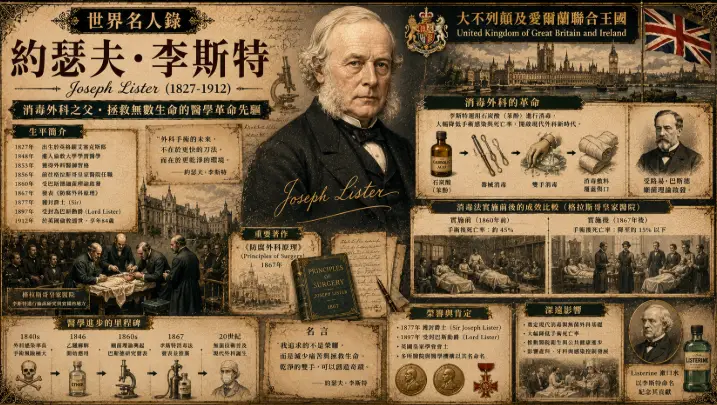
約瑟夫·李斯特出生於1827年的英格蘭艾塞克斯郡,當時的大不列顛及愛爾蘭聯合王國正處於工業革命與科學快速發展的年代。李斯特出身於一個重視教育與科學的家庭,父親約瑟夫·傑克森·李斯特是一位成功商人,同時也是著名顯微鏡改良者。他對光學與科學研究的熱情深深影響了年幼的李斯特,使他從小便對自然科學與醫學產生濃厚興趣。由於家庭屬於貴格會教徒,李斯特自幼接受嚴格道德教育,也培養出細心、冷靜與嚴謹的個性。年輕時的李斯特進入倫敦大學學習醫學,並在醫院接受外科訓練。十九世紀中期的外科醫學仍極度危險,即使手術本身成功,病人也經常因感染而死亡。當時醫學界尚未真正理解細菌與感染關係,許多醫師認為傷口化膿屬於正常現象。醫院環境衛生極差,手術器械與醫師雙手往往未經清潔,導致大量病人術後出現敗血症、壞疽與高燒。李斯特在臨床工作中親眼見證無數病人因感染而痛苦死亡,這讓他開始思考如何改善外科治療。1850年代後期,李斯特前往蘇格蘭格拉斯哥大學擔任外科醫師與教授。當時格拉斯哥是工業城市,大量工人因工業事故受傷,使外科醫療需求極高。然而,醫院感染率同樣驚人。李斯特對此深感不安,也開始研究法國科學家路易·巴斯德提出的「細菌理論」。巴斯德認為微生物會導致腐敗與發酵,這項觀念啟發李斯特思考:若細菌能造成食物腐敗,是否也可能造成傷口感染?這種想法在當時極具革命性。1860年代,李斯特開始嘗試以石炭酸,也就是苯酚,作為消毒劑。他使用石炭酸清潔手術器械、醫師雙手與病人傷口,並以含石炭酸敷料覆蓋創口。結果顯示,病人感染率與死亡率大幅下降。1867年,李斯特正式發表「防腐外科」理論,主張手術過程應避免細菌進入傷口。這項觀念徹底改變外科醫學發展方向。雖然今日消毒被視為理所當然,但在當時許多醫師對李斯特理論抱持懷疑甚至嘲笑態度。有些外科醫師拒絕接受細菌存在,也不願改變傳統手術習慣。然而,隨著越來越多成功案例出現,李斯特的方法逐漸獲得認同。後來歐洲與美國醫院開始廣泛採用消毒措施,外科手術死亡率顯著下降,現代外科醫學因此真正得以快速發展。李斯特的貢獻不只在於消毒技術本身,更在於他將科學實驗與醫療實務緊密結合。他強調醫學必須建立在觀察、證據與微生物理論基礎之上,而不是單靠傳統經驗。這種理念深刻影響後來醫學研究與公共衛生發展。除了外科手術外,消毒概念也逐漸擴展至產科、牙科與一般醫院管理。李斯特晚年成為英國最受尊敬的醫學人物之一。他曾擔任英國皇家學會會長,也獲封爵位,成為第一位被封為貴族的外科醫師。許多醫院與醫學機構以他名字命名,「Listerine」漱口水名稱也源自對他的紀念。儘管享有巨大聲望,李斯特本人性格依然低調謙遜。他始終相信,醫學真正目的在於減輕人類痛苦,而非追求個人榮耀。1912年,約瑟夫·李斯特於英格蘭逝世,享年84歲。後世普遍將他視為現代外科醫學最重要奠基者之一。歷史學家認為,若沒有李斯特推動的消毒革命,許多現代手術根本無法安全進行。從心臟手術、器官移植到現代急診醫療,幾乎所有外科領域都建立在他提出的防感染原則之上。對大不列顛及愛爾蘭聯合王國而言,李斯特也象徵十九世紀英國科學與醫學力量的巔峰時代。他以科學與人道精神改變全球醫療歷史,也讓數以億計病人因此獲得更安全的治療機會。
English Version
Joseph Lister was born in 1827 in Essex, England, during the height of the Industrial Revolution in the United Kingdom of Great Britain and Ireland. Britain at the time was becoming a global center of science, technology, and medicine, and Lister grew up in a family deeply interested in scientific advancement. His father, Joseph Jackson Lister, was a successful businessman and an important pioneer in microscope design whose improvements greatly enhanced optical research. Surrounded by scientific curiosity from childhood, young Joseph developed an early fascination with biology, anatomy, and the natural world. Raised within the Quaker tradition, he was taught discipline, humility, and careful observation, qualities that later shaped his approach to medicine and research. Lister studied medicine at University College London, where he received training in surgery during a period when operations remained extraordinarily dangerous. In the mid-nineteenth century, surgeons could perform amputations and major procedures with increasing speed thanks to the use of anesthesia, but postoperative infections killed enormous numbers of patients. Hospitals were often filthy, surgical instruments were reused without cleaning, and doctors operated with bare, unwashed hands. Many physicians believed that pus and infection were unavoidable parts of healing. Diseases such as gangrene, septicemia, and surgical fever frequently spread through crowded hospital wards. Lister witnessed countless patients die after otherwise successful surgeries, and these experiences convinced him that something within the medical environment itself was causing the deadly infections. In the late 1850s, Lister accepted a position in Glasgow, Scotland, where industrial injuries provided surgeons with a constant flow of complex cases. While working there, he became deeply interested in the work of French chemist Louis Pasteur, who had proposed that microscopic organisms caused fermentation and decay. Pasteur’s germ theory inspired Lister to consider whether invisible microbes might also be responsible for wound infections and surgical deaths. This idea was revolutionary because most doctors still rejected the concept of microorganisms causing disease. Lister began experimenting with carbolic acid, also known as phenol, which was already being used to reduce foul odors in sewage systems. He applied the substance to surgical instruments, dressings, wounds, and even the air surrounding operations. The results were remarkable. Patients treated with Lister’s antiseptic methods experienced dramatically lower infection and mortality rates. In 1867, he formally published his findings and introduced the principles of antiseptic surgery to the medical world. Although today sterilization and disinfection are considered basic medical practices, many physicians initially reacted with skepticism or ridicule. Some surgeons refused to believe that invisible organisms existed, while others resisted changing long-established habits. Nevertheless, the undeniable success of Lister’s methods gradually persuaded hospitals across Europe and North America to adopt antiseptic procedures. As infection rates fell, surgery transformed from a desperate last resort into a far safer and more effective branch of medicine. Lister’s influence extended far beyond antiseptic chemicals alone. He fundamentally changed the philosophy of medicine by insisting that surgery must be guided by scientific evidence, laboratory research, and careful observation rather than tradition or guesswork. His work helped establish the importance of sterile environments, hygienic instruments, and infection prevention throughout modern healthcare. The principles he introduced eventually spread into obstetrics, dentistry, emergency medicine, and public health systems around the world. During his later years, Lister became one of Britain’s most respected scientific figures. He served as president of the Royal Society and received numerous international honors. Queen Victoria elevated him to the peerage, making him the first surgeon in British history to receive such recognition. His name became permanently associated with cleanliness and antiseptic medicine, and even the antiseptic mouthwash “Listerine” was named in tribute to him. Despite his fame, Lister remained personally modest and deeply committed to reducing human suffering through scientific progress. Joseph Lister died in 1912 at the age of eighty-four. Historians now regard him as one of the founding architects of modern surgery. Without the antiseptic revolution he initiated, many forms of advanced surgery—including organ transplantation, cardiac operations, and emergency trauma procedures—would have remained impossible or fatally dangerous. His discoveries saved millions of lives and transformed hospitals from places of infection into centers of healing. For the United Kingdom, Lister also symbolized the extraordinary scientific achievements of nineteenth-century Britain and its leading role in the development of modern medicine. Today, nearly every surgical procedure performed anywhere in the world still reflects the principles first championed by Joseph Lister more than a century ago.