
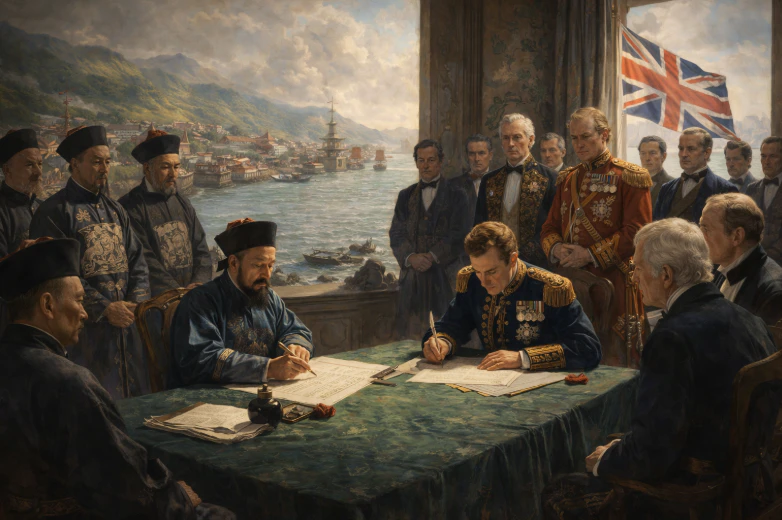
1842年南京條約簽訂,不僅結束鴉片戰爭,更正式開啟香港殖民地時代,深遠影響中英關係與東亞歷史。
The 1842 agreement that ended war also reshaped power in East Asia, giving rise to a colonial port that would transform regional trade and global connections.
中文
1842年,《南京條約》的簽訂標誌著鴉片戰爭的結束,同時亦揭開中國近代史一個全新而沉重的篇章。在戰爭過程中,清朝面對英國現代化軍事力量節節敗退,沿海防線相繼失守,最終被迫與英國展開談判,這場談判並非在平等條件下進行,而是在軍事壓力與政治劣勢下作出的妥協。《南京條約》成為中國歷史上第一個不平等條約,其內容深刻改變了中國的主權結構與對外關係,其中最具象徵性的條款之一,便是將香港島正式割讓予英國,這一決定不僅為英國在遠東建立穩固據點,也為香港的歷史發展奠定方向。條約同時規定開放廣州、廈門、福州、寧波及上海五個通商口岸,允許外國商人自由貿易,並設立領事制度,使外國勢力得以在中國境內擴展影響力。此外,清政府需支付巨額賠款,進一步加重國家財政負擔,加速社會經濟壓力。對香港而言,這一條約的簽訂意味著其身份由戰時佔領地轉變為正式殖民地,英國開始全面推行殖民統治,包括建立行政制度、法律體系及城市規劃,使香港逐漸發展為自由港與國際貿易中心。維多利亞港的天然深水優勢迅速發揮作用,吸引大量航運與商業活動,使香港在短時間內成為區域重要的轉口港。與此同時,人口結構亦出現變化,大量華人移民湧入尋求工作機會,形成多元社會結構,而英國的管治模式亦逐步影響教育、司法及城市發展,使香港呈現中西融合的獨特面貌。《南京條約》的影響遠遠超出香港本身,它開啟了列強與中國簽訂一系列不平等條約的先例,使中國逐步被納入西方主導的國際體系,亦標誌著傳統朝貢體系的瓦解。從歷史角度看,這不僅是一份戰敗條約,更是一個時代轉折點,它象徵中國由封閉走向被迫開放,也象徵香港由邊陲小島邁向國際城市的起點。南京條約與香港殖民地的建立互為因果,兩者共同構成東亞近代歷史的重要基石,其影響延續至今,成為理解全球化早期形態與區域權力重組的關鍵事件。
English Version
The signing of the Treaty of Nanking in 1842 marked far more than the conclusion of a military conflict; it represented a profound transformation in the balance of power between China and the Western world, setting in motion a chain of events that would redefine the region for decades to come. After suffering repeated defeats at the hands of a technologically superior British navy, the Qing Empire found itself in a position where negotiation was not a matter of diplomacy but necessity, conducted under the pressure of continued military threat. The resulting agreement established a new framework for relations that departed sharply from China’s traditional worldview, in which it had long seen itself as the dominant center of civilization. Among the treaty’s most consequential provisions was the formal cession of Hong Kong Island to Britain, an act that provided the British Empire with a permanent strategic foothold in East Asia and enabled it to expand its commercial and political influence in the region. At the same time, the treaty required the opening of several key ports to foreign trade, including Canton, Amoy, Foochow, Ningpo, and Shanghai, thereby dismantling long-standing restrictions and allowing foreign merchants to operate with unprecedented freedom within Chinese territory. Financial indemnities imposed on the Qing government further weakened its economic stability, while the introduction of foreign consular presence signaled a growing erosion of sovereignty. For Hong Kong, the implications were transformative; no longer merely a temporary military outpost, it became an official colony under British rule, where a new administrative and legal system was established and urban development began in earnest. The island’s deep natural harbor quickly emerged as one of its greatest assets, supporting the growth of maritime trade networks that connected China to global markets, and attracting merchants, investors, and migrants from diverse backgrounds. Over time, this influx of people and capital contributed to the formation of a dynamic, multicultural society that blended Chinese traditions with Western institutions, giving Hong Kong its distinctive character. Beyond its immediate effects, the treaty also set a precedent that would shape China’s interactions with foreign powers throughout the 19th century, as additional agreements imposed similar terms and further integrated the country into an international system dominated by Western interests. In this sense, the Treaty of Nanking was not simply a peace settlement but a turning point that signaled the decline of an old order and the emergence of a new global reality. It simultaneously marked the beginning of Hong Kong’s rise as a major port city and highlighted the broader shifts that were reshaping East Asia during this period, making it a critical moment in the history of globalization and imperial expansion.