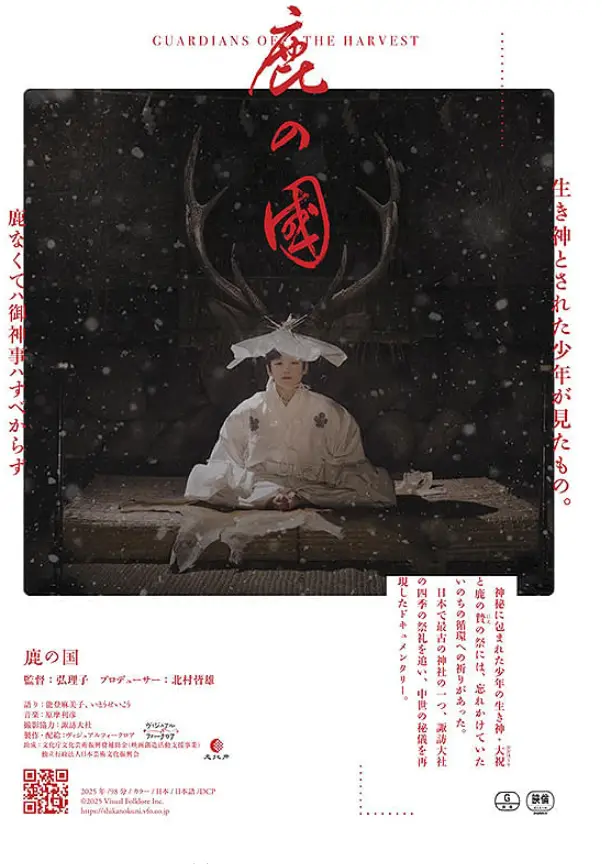

《鹿之國》走進長野縣諏訪大社四季祭禮,以自然信仰、生命循環與古老神事為核心,追尋被歷史與神秘包圍的諏訪文化。
The Land of Deer explores the seasonal rituals of Suwa Taisha in Nagano, revealing an ancient spiritual world shaped by nature worship, the cycle of life, and mysterious ceremonies preserved across generations.
電影內容|中文版本
《鹿之國》是一部以日本長野縣諏訪盆地為舞台的紀錄片,由弘理子執導,深入記錄日本最古老神社之一諏訪大社的四季祭禮與古老信仰。諏訪大社位於諏訪湖周圍,由上社前宮、上社本宮、下社春宮及下社秋宮四座神社組成,其起源可以追溯至《古事記》中的國讓神話。與許多以具體神像作為信仰核心的神社不同,諏訪大社保存著將自然本身視為神體的古老信仰形式,因此山林、土地、生命與季節變化都與祭祀文化密不可分。《鹿之國》並沒有單純把諏訪大社當作旅遊景點介紹,而是將攝影機放進一年四季的祭禮之中,觀察人們如何透過延續至今的儀式,向自然與生命表達最原初的敬畏與祈願。四季在這裡不只是時間的變化,也象徵生命循環與人類與自然之間長久建立的關係。電影最重要的部分之一,是重新面對諏訪中世時期充滿神秘色彩的「御室神事」。這項古老神事長期被畏懼與謎團包圍,作品透過重現的方式,嘗試讓觀眾理解這段已經遠離現代生活的宗教文化。傳統儀式中,一名少年被視為具有神聖生命意義的「大祝」,在冬季被安置於神域內的穴倉之中,並在特殊的環境裡度過冬天。電影將鏡頭帶向這段神事背後的文化想像,呈現人、神域、自然與生命之間特殊而難以用現代眼光完全解釋的關係。到了春季,大祝重新出現,並經過化妝與儀式準備,而另一個更加令人疑惑的傳統亦浮現眼前:75頭鹿的獻祭。這些鹿被獻給春季出現的大祝,而這項儀式背後究竟代表什麼,一直是諏訪古代文化中令人難以完全解開的謎。電影因此不只是記錄一項祭典,而是試圖追問這些儀式究竟承載著怎樣的生命觀、自然觀與宗教思想。為了深入理解諏訪的古代歷史,作品由長年研究諏訪古代史的電影導演兼影像民俗學者北村皆雄擔任製作人,並由曾經以尼泊爾與西藏生死文化為題材製作紀錄片的弘理子執導。兩人的創作方向,使電影不只停留在表面上的祭典影像,而是從民俗學、宗教文化與生命觀等角度,重新觀看諏訪大社保存至今的古老傳統。影片獲得諏訪大社的拍攝協力,並歷時三年完成,讓四季祭禮與神事可以在較完整的時間跨度中被記錄。這種長期拍攝方式亦使電影能夠呈現祭禮並非單一日子的活動,而是與季節、土地以及人們生活節奏互相連結的文化系統。作品的聲音設計亦具有重要角色,聲優能登麻美子與創作者伊藤精光擔任旁白,以不同聲音引導觀眾進入這個古老而神秘的文化世界;音樂則由在日本及海外均受到高度評價的音樂家原摩利彦負責,為影像增添另一層氛圍。整部作品最值得關注的地方,是它如何從「鹿」與「祭禮」出發,進一步思考生命循環。鹿在電影中並不只是自然界的動物,也成為理解諏訪古代祭祀文化的重要象徵。當75頭鹿被獻祭給大祝,觀眾所看到的不只是古老儀式的奇異與震撼,同時也會面對生命、死亡、奉獻與再生之間複雜的關係。作品因此帶有紀錄片的觀察性,也具有民俗文化探索的深度。從冬季到春季,從神域到人間,從自然到祭祀,《鹿之國》將諏訪大社的四季祭禮與御室神事放在同一條文化脈絡中,嘗試追尋一種比現代生活更古老的世界觀。對觀眾而言,這是一場進入日本古代信仰深處的影像旅程,也是一個重新思考人與自然如何相處的機會。電影沒有把古老神事簡單定義成已經過去的歷史,而是透過現代紀錄影像,讓這些仍然存在於諏訪土地上的儀式重新被觀看。當四季更替、祭禮再次開始,古老的祈願也在新的時代繼續延續。《鹿之國》最終呈現的,是一個以自然為神體、以祭禮維繫生命循環想像的諏訪世界,以及那些至今仍未完全被解開的歷史謎團。
English Version
The Land of Deer is a documentary directed by Hiroko Taira that explores the seasonal rituals and ancient beliefs surrounding Suwa Taisha in the Suwa Basin of Nagano Prefecture, Japan. Located around Lake Suwa, the shrine complex consists of four major sites: Kamisha Maemiya, Kamisha Honmiya, Shimosha Harumiya and Shimosha Akimiya. Its origins reach back to the land-transfer mythology recorded in the Kojiki, placing the shrine within a religious history that predates much of modern Japan. One of the most distinctive aspects of Suwa’s ancient tradition is the belief that nature itself can serve as the object of worship. Rather than separating the sacred from the natural environment, this worldview treats mountains, forests, land, seasons and living things as part of a larger spiritual relationship. The documentary follows the shrine’s rituals throughout the four seasons, observing how these ceremonies continue to express an ancient human desire to understand and honour the cycle of life. The film does not simply present Suwa Taisha as a historical monument or tourist destination. Instead, it uses the changing seasons and ritual calendar to explore the relationship between people, nature and the sacred. Through the ceremonies, the audience encounters a worldview in which the renewal of life, the passing of time and the natural environment are closely connected. One of the film’s most intriguing subjects is the medieval ritual known as the Mimuro Shinji. Surrounded for centuries by fear, mystery and unanswered questions, the ceremony represents a particularly difficult part of Suwa’s religious history to understand from a modern perspective. The documentary reconstructs aspects of this ancient ritual in an attempt to explore what it may have meant within the spiritual culture of its time. At the centre of the reconstructed ceremony is the figure of the Ohori, a young boy regarded as a living sacred presence. During winter, the boy was confined within an underground chamber located in a sacred area. His isolation and ritual status created a distinctive relationship between human life, the sacred landscape and the passage of the seasons. When spring arrived, the Ohori emerged after being ceremonially prepared and made up. His appearance was connected with another mysterious element of the tradition: the offering of 75 deer. The deer were sacrificed and dedicated to the Ohori, leaving behind one of the most striking and difficult questions surrounding the ancient rituals of Suwa. Why were so many deer offered, and what did the act represent within the religious imagination of the time? Rather than presenting a simple answer, the documentary approaches the mystery as part of a larger exploration of life, death, sacrifice and renewal. The deer become more than animals within the ritual. They form part of a symbolic system through which the relationship between humans, nature and the sacred can be examined. The production was developed under the guidance of film director and visual ethnologist Minuo Kitamura, who has spent many years researching the ancient history of Suwa. Hiroko Taira, who directed the film, had previously created documentaries dealing with cultural traditions surrounding life and death in Nepal and Tibet. Their combined perspectives allow the film to approach Suwa’s traditions through both documentary observation and ethnographic inquiry. With cooperation from Suwa Taisha during filming, the production took three years to complete. This extended production period is particularly important because the rituals are not isolated events but part of an annual cycle connected to the changing seasons and the cultural rhythm of the region. By following the rituals over time, the film can observe how ancient traditions continue to exist within the landscape rather than presenting them simply as historical reconstructions. The film’s soundscape also contributes to its atmosphere. Voice actress Mamiko Noto and creator Seiko Ito provide narration, while internationally recognised musician Marihiko Hara composed the music. Their contributions create an additional layer through which the audience can enter the documentary’s mysterious and contemplative world. At its heart, The Land of Deer is a film about the cycle of life and the ancient ways humans have attempted to understand it. The seasonal rituals of Suwa Taisha provide the framework, while the Mimuro Shinji and the offering of 75 deer reveal a deeper and more unsettling side of the region’s religious history. Life and death are not presented as separate concepts. Instead, they appear as parts of an ongoing cycle involving nature, ritual, sacrifice and renewal. This perspective makes the film more than a record of traditional ceremonies. It becomes an investigation into an ancient worldview in which the natural environment itself is sacred. The journey from winter to spring, from the hidden sacred chamber to the reappearance of the Ohori, and from the deer offerings to the continuation of seasonal rituals allows the documentary to explore a cultural system that has survived across generations. For contemporary audiences, the film offers an opportunity to encounter a form of Japanese spirituality that cannot easily be separated from the land in which it developed. It also invites viewers to consider how ancient societies understood their relationship with animals, nature and the forces they could neither control nor fully explain. Rather than reducing the mysterious rituals of Suwa to simple historical facts, The Land of Deer allows their unanswered questions to remain part of the experience. Through three years of filming, seasonal observation and ritual reconstruction, the documentary presents Suwa Taisha as a living cultural landscape where ancient beliefs continue to meet the present. The result is a quiet but profound exploration of nature worship, ritual, sacrifice, mystery and the enduring human search for meaning within the cycle of life.
影片簡介|Short Description
紀錄片《鹿之國》追蹤諏訪大社四季祭禮,探索自然信仰、生命循環與神秘的御室神事。
The Land of Deer follows the seasonal rituals of Suwa Taisha, exploring nature worship, the cycle of life and the mysterious Mimuro Shinji ceremony.
電影資料
導演:弘理子
類型:紀錄片、民俗、歷史、宗教文化
上映年份:2025
主要演員
能登麻美子(旁白)
いとうせいこう(旁白)
總結
《鹿之國》以三年時間走進諏訪大社四季祭禮,並重現神秘的御室神事。從自然信仰到75頭鹿的獻祭,電影在古老儀式中尋找人與自然、生命與死亡之間的關係。
The Land of Deer spends three years documenting the seasonal rituals of Suwa Taisha while reconstructing the mysterious Mimuro Shinji. Through nature worship and the offering of 75 deer, the film explores the ancient relationship between humanity, nature, life and death.