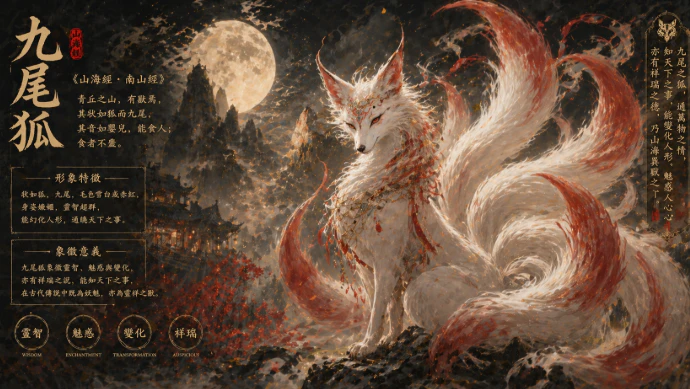
九尾狐,是中國神話中最具爭議與魅力的靈獸之一,既象徵祥瑞與智慧,也常被視為誘惑與幻化的妖魅存在。在《山海經》中,它的形象尚屬中性甚至帶有神聖意味,但在後世文學中逐漸轉變為複雜的文化符號。本文將探討九尾狐如何在不同時代被重新詮釋,以及其背後的深層意義。
The Nine-Tailed Fox is one of the most fascinating and controversial creatures in Chinese mythology, symbolizing both wisdom and danger. In Shan Hai Jing, it appears as a neutral or even auspicious being, but later evolves into a complex symbol of seduction and transformation. This article explores how its meaning shifts across time and culture.
九尾狐在中國神話體系中佔據著一個極為特殊的位置,它既不是純粹的神獸,也不完全等同於妖怪,而是一種介於兩者之間的存在。在《山海經》的記載中,九尾狐被描述為一種具有九條尾巴的狐狸,聲音如嬰兒啼哭,食其肉可以使人不受邪氣侵擾,這種描述顯示出它在最早期的形象中帶有某種神聖或守護的性質。與後世妖狐的形象相比,這裡的九尾狐更接近於自然靈獸,是天地間特殊能量的具現。然而,隨著時代演變,九尾狐逐漸被賦予更多人性與情感,並開始出現在志怪小說與民間傳說之中,成為能夠幻化為人形的存在,特別是以女性形象出現,與人類建立關係。這一轉變使九尾狐從自然之靈轉變為文化象徵,其意義也變得更加複雜。一方面,它被描繪為誘惑與危險的象徵,代表慾望與幻象,警示人們不要沉溺於虛假之中;另一方面,它也可能成為忠誠與守護的存在,在某些故事中,九尾狐與人類建立深厚情感,甚至犧牲自身來保護對方。這種雙重性,使九尾狐成為一個極具張力的符號,它同時承載著人類對未知的恐懼與對情感的渴望。從文化角度來看,九尾狐的形象變化,反映了社會價值觀的轉變,尤其是在性別與道德觀念上的投射。在某些時期,九尾狐被視為禍亂之源,例如與王朝衰亡相關聯,這種敘述將其與危險與混亂緊密結合;而在另一些作品中,它則被重新詮釋為具有獨立意志與情感的角色,甚至帶有悲劇色彩。這種演變顯示出神話並非固定不變,而是會隨著文化與時代的不同而被重新塑造。在現代語境中,九尾狐可以被理解為一種「身份流動」的象徵,它能夠跨越人與獸、真與幻的界線,挑戰固定的分類與認知。這種模糊性正是其魅力所在,也使其在當代文化中依然具有吸引力。透過九尾狐的故事,我們可以看到人類如何透過神話來理解慾望、恐懼與關係,並在這些故事中反思自身的處境。九尾狐既可能是妖魅,也可能是守護者,而這種不確定性,正是它歷久不衰的原因。
English Version
The Nine-Tailed Fox occupies a uniquely complex position in Chinese mythology, existing somewhere between a divine creature and a supernatural being. In its earliest appearances in Shan Hai Jing, it is described as a fox with nine tails and a voice resembling that of a crying infant, and its flesh is believed to offer protection against evil influences. This portrayal suggests that the creature was originally seen as auspicious or at least neutral, embodying a form of natural spiritual power rather than malevolence. Over time, however, the image of the Nine-Tailed Fox evolves significantly. As it enters later folklore and literary traditions, it gains the ability to transform into human form, often appearing as a woman and interacting with human society. This shift introduces layers of emotion, intention, and narrative complexity, transforming the fox from a natural spirit into a cultural symbol. On one hand, it becomes associated with seduction, illusion, and moral danger, serving as a warning against deception and uncontrolled desire. On the other hand, it can also be portrayed as loyal, compassionate, and even self-sacrificial, forming deep bonds with humans. This duality is central to its enduring appeal. It reflects a broader human tension between attraction and fear, between the desire for connection and the risk of loss or illusion. From a cultural perspective, the transformation of the Nine-Tailed Fox mirrors shifting social values, particularly in relation to gender and morality. In some narratives, it is linked to chaos and the downfall of rulers, reinforcing its association with danger and disruption. In others, it is reimagined as a tragic or sympathetic figure, endowed with agency and emotional depth. This evolution demonstrates that mythology is not static; it adapts to the concerns and imagination of each era. In modern interpretations, the Nine-Tailed Fox can be seen as a symbol of fluid identity, capable of crossing boundaries between human and animal, reality and illusion. This ambiguity challenges rigid classifications and invites reflection on transformation and perception. Through its many forms, the Nine-Tailed Fox continues to captivate, not because it offers clear answers, but because it embodies the uncertainty and complexity of existence itself.