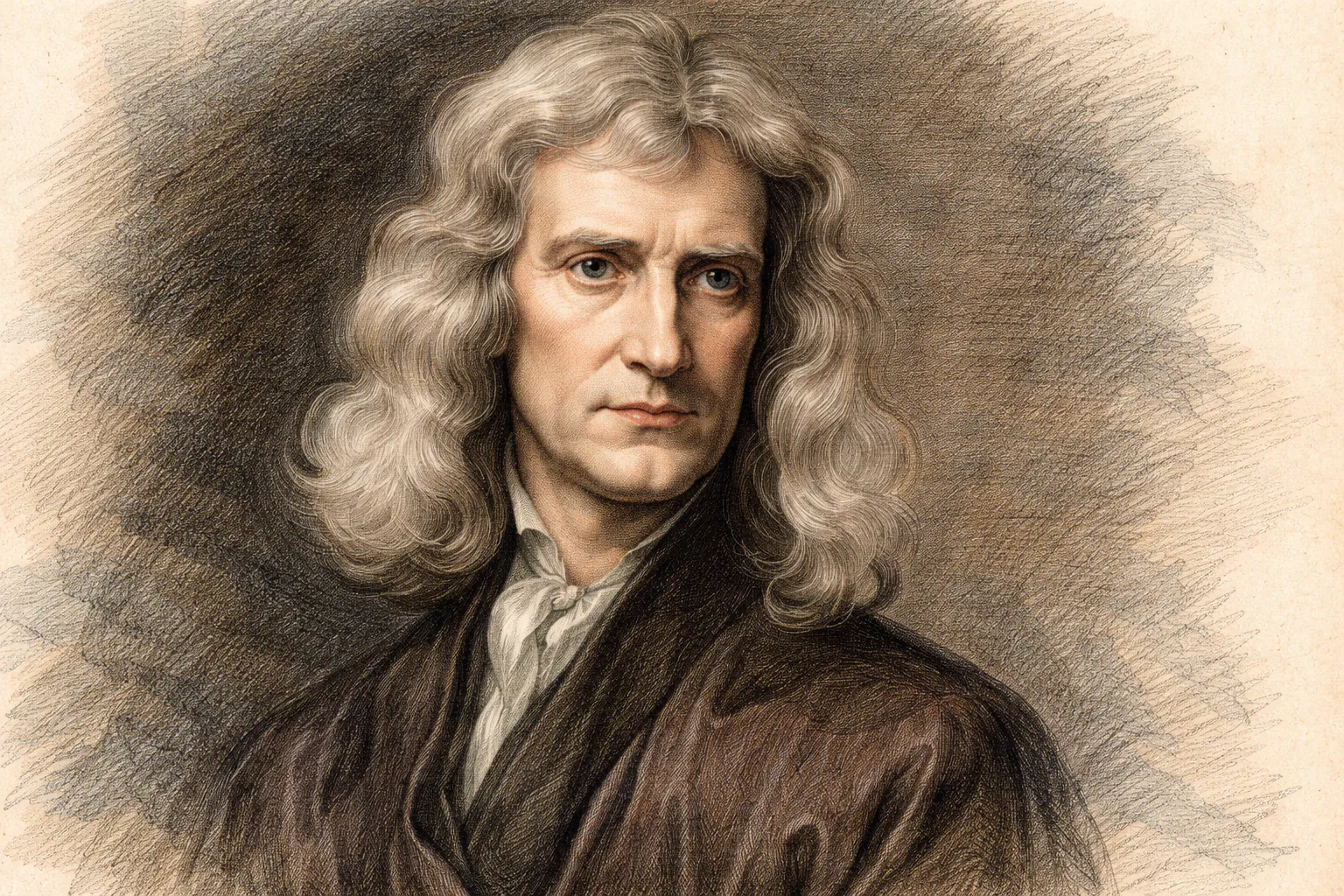
艾薩克·牛頓(Isaac Newton)是17世紀最偉大的科學家之一,也是近代科學革命的核心人物。他在物理學、數學與天文學領域作出巨大貢獻,其中最著名的是提出萬有引力定律與運動三大定律,建立經典力學的基礎。牛頓的著作《自然哲學的數學原理》被視為科學史上最重要的書籍之一,對後世科學發展影響深遠。他的研究讓人類第一次以數學與物理法則理解宇宙運動。
Isaac Newton (1643–1727) was one of the most influential scientists in history, widely regarded as a key figure in the Scientific Revolution. An English mathematician, physicist, and astronomer, Newton formulated the laws of motion and universal gravitation, laying the foundation for classical mechanics. His groundbreaking work Philosophiæ Naturalis Principia Mathematica revolutionized science and shaped our understanding of the physical universe. Beyond physics, Newton made significant contributions to mathematics, including the development of calculus, and advanced the study of optics through experiments with light and prisms. His discoveries not only transformed science in his own time but also influenced centuries of scientific thought and technological advancement.
在人類科學史上,艾薩克·牛頓被認為是最偉大的科學家之一。他的研究將物理學、數學與天文學結合起來,使人類第一次能夠用數學公式解釋自然界的運動規律。牛頓的理論不僅改變了科學,也深刻影響了人類對宇宙的理解。
牛頓於1643年出生於英格蘭林肯郡的一個小村莊伍爾索普。他出生時體弱多病,甚至有人認為他難以存活。然而這位體弱的嬰兒日後卻成為科學史上最重要的人物之一。
牛頓的父親在他出生前便去世,母親後來再婚,因此他在童年時期主要由外祖母撫養。年幼的牛頓性格內向,但對機械與自然現象充滿好奇。他常常製作各種小裝置,例如風車模型與機械鐘。
後來,牛頓進入劍橋大學三一學院學習。當時歐洲正處於科學革命時期,許多學者開始挑戰傳統自然哲學。牛頓在大學中接觸到伽利略、開普勒與笛卡兒等人的研究,並逐漸形成自己的科學思想。
1665年,英國爆發大瘟疫,劍橋大學暫時關閉。牛頓回到家鄉度過兩年的時間。這段期間後來被稱為他的「奇蹟年代」,因為他在這段時間中完成許多重要思想。
據說在一次觀察中,牛頓看到蘋果從樹上落下,這使他開始思考一個問題:為什麼物體會向地面落下?是否存在一種普遍的力量控制著物體的運動?
透過研究與計算,牛頓提出「萬有引力定律」。這一定律指出,宇宙中任何兩個物體之間都存在相互吸引的力量,而這種力量與物體質量成正比,與距離平方成反比。
這一理論具有革命性意義,因為它不僅解釋了物體落地的原因,也解釋了行星繞太陽運行的原因。地球上的運動與天體運動第一次被同一套物理法則統一起來。
除了引力定律之外,牛頓還提出著名的運動三大定律。第一定律是慣性定律,指出物體會保持原有運動狀態,除非受到外力影響。第二定律描述力與加速度之間的關係。第三定律則指出作用力與反作用力大小相等、方向相反。
這三條定律成為經典力學的基礎,使人類能夠精確計算物體的運動。
牛頓在數學方面也做出重大貢獻。他與德國數學家萊布尼茲幾乎同時發明微積分。微積分成為研究變化與運動的重要數學工具,在科學與工程中廣泛應用。
在光學研究方面,牛頓也有重要發現。他利用棱鏡實驗證明白光其實由多種不同顏色的光組成,並提出光的粒子理論。
1687年,牛頓出版了科學史上最重要的著作之一《自然哲學的數學原理》。在這本書中,他系統地闡述運動定律與萬有引力理論,並利用數學方法解釋行星運動。
這本書被認為是科學革命的重要里程碑。許多科學家認為,從牛頓開始,自然界的規律可以透過數學精確描述。
牛頓後來也參與英國政府工作。他曾擔任皇家鑄幣局局長,負責改革英國貨幣制度。之後,他被任命為英國皇家學會會長,成為科學界的重要領袖。
1705年,英國女王安妮授予牛頓爵士稱號,使他成為第一位獲得爵位的科學家。
牛頓於1727年去世,享年84歲。他被安葬在倫敦的西敏寺,與英國歷史上的偉大人物並列。
在科學史上,牛頓的地位極其重要。他的理論統治科學界長達兩百多年,直到20世紀愛因斯坦提出相對論後才被部分修正。
然而即使如此,牛頓力學仍然是工程與日常物理計算的重要基礎。例如航天工程、建築設計與機械運動分析都依賴這些原理。
牛頓曾說:「如果我看得更遠,那是因為我站在巨人的肩膀上。」這句話顯示他對前人科學家的尊重。
今天,人類對宇宙的理解已經更加深入,但牛頓建立的科學框架仍然是現代科學的重要基石。
正因如此,艾薩克·牛頓被視為近代科學最偉大的奠基者之一。他的研究讓人類第一次真正理解自然界的數學秩序,也開啟了現代科學的新時代。
English Version
Isaac Newton stands as one of the most towering figures in the history of science, a man whose insights reshaped humanity’s understanding of the natural world and established the foundations of modern physics and mathematics. Born on January 4, 1643 (December 25, 1642, in the Julian calendar), in Woolsthorpe, England, Newton entered the world prematurely and was not expected to survive. Yet, from these fragile beginnings emerged a mind of extraordinary power, one that would go on to revolutionize science during the period now known as the Scientific Revolution.
Newton’s early life was marked by solitude and introspection. Raised by his grandmother after his mother remarried, he developed a deeply independent personality. He later attended the University of Cambridge, where he studied mathematics and natural philosophy. It was during the closure of the university due to the Great Plague (1665–1666) that Newton experienced what is often referred to as his “annus mirabilis,” or miraculous year. During this period of isolation, he made groundbreaking discoveries in calculus, optics, and the laws of motion.
One of Newton’s most famous contributions is his formulation of the three laws of motion, which describe how objects move under the influence of forces. These laws provided a unified framework for understanding both terrestrial and celestial motion. Equally transformative was his law of universal gravitation, which proposed that every object in the universe attracts every other object with a force proportional to their masses and inversely proportional to the square of the distance between them. This insight elegantly explained phenomena ranging from the falling of an apple to the orbits of planets.
Newton’s work reached its pinnacle in his monumental book Philosophiæ Naturalis Principia Mathematica, commonly known as the Principia, published in 1687. In this work, Newton synthesized his discoveries into a coherent mathematical framework, demonstrating that the same physical laws govern both the heavens and the Earth. The Principia is widely regarded as one of the most important scientific works ever written, marking a turning point in the development of science.
In addition to his work in mechanics, Newton made significant advances in optics. Through experiments with prisms, he demonstrated that white light is composed of a spectrum of colors. This challenged existing theories of light and laid the groundwork for modern optical science. He also invented the reflecting telescope, which used mirrors instead of lenses, significantly improving the quality of astronomical observations.
Newton’s contributions to mathematics were equally profound. He independently developed calculus, a powerful mathematical tool essential for describing change and motion. Although there was controversy over priority with the German mathematician Gottfried Wilhelm Leibniz, both are now recognized as co-inventors of calculus. Newton’s mathematical methods provided the language necessary for expressing the laws of physics with precision.
Despite his scientific genius, Newton was a complex and sometimes difficult personality. He was known to be secretive, intensely focused, and occasionally involved in bitter disputes with contemporaries. Beyond science, he had deep interests in alchemy, theology, and biblical chronology, fields that occupied a significant portion of his later life.
Newton’s career extended beyond academia. He served as Warden and later Master of the Royal Mint, where he played a crucial role in reforming England’s currency. He was also elected President of the Royal Society, one of the most prestigious scientific institutions of the time, and was knighted in 1705, becoming Sir Isaac Newton.
Newton died on March 31, 1727, and was buried in Westminster Abbey, an honor reserved for Britain’s most distinguished figures. His legacy endures not only in the scientific principles that bear his name but also in the intellectual framework he established. For over two centuries, Newtonian physics dominated scientific thought, providing a reliable model of the universe until it was later expanded by the theories of relativity and quantum mechanics.
What makes Newton’s work so remarkable is its universality and precision. He demonstrated that the universe operates according to consistent, discoverable laws, a concept that became a cornerstone of modern science. His ability to combine observation, experimentation, and mathematical reasoning set a standard for scientific inquiry that remains influential today.
In many respects, Isaac Newton did not merely contribute to science—he redefined it. His work transformed the way humanity perceives motion, force, and the structure of the cosmos, leaving an enduring legacy that continues to shape our understanding of the universe.