
香港山怪談|柏架山舊石屋:密林深處那間沒有門的屋 | Mount Parker Stone House Mystery: The Doorless Hut in Hong Kong’s Forest | Urban Legend
柏架山的山路向來靜謐,特別是深入其中,連手機訊號都隨之消失,彷彿進入了另一個世界。那天,我和幾個朋友從大潭水塘出發,沿著一條蜿蜒的小徑上山。樹影遮天蔽日,只有稀疏的陽光透過枝葉灑下,地上的落葉被踩得沙沙作響。
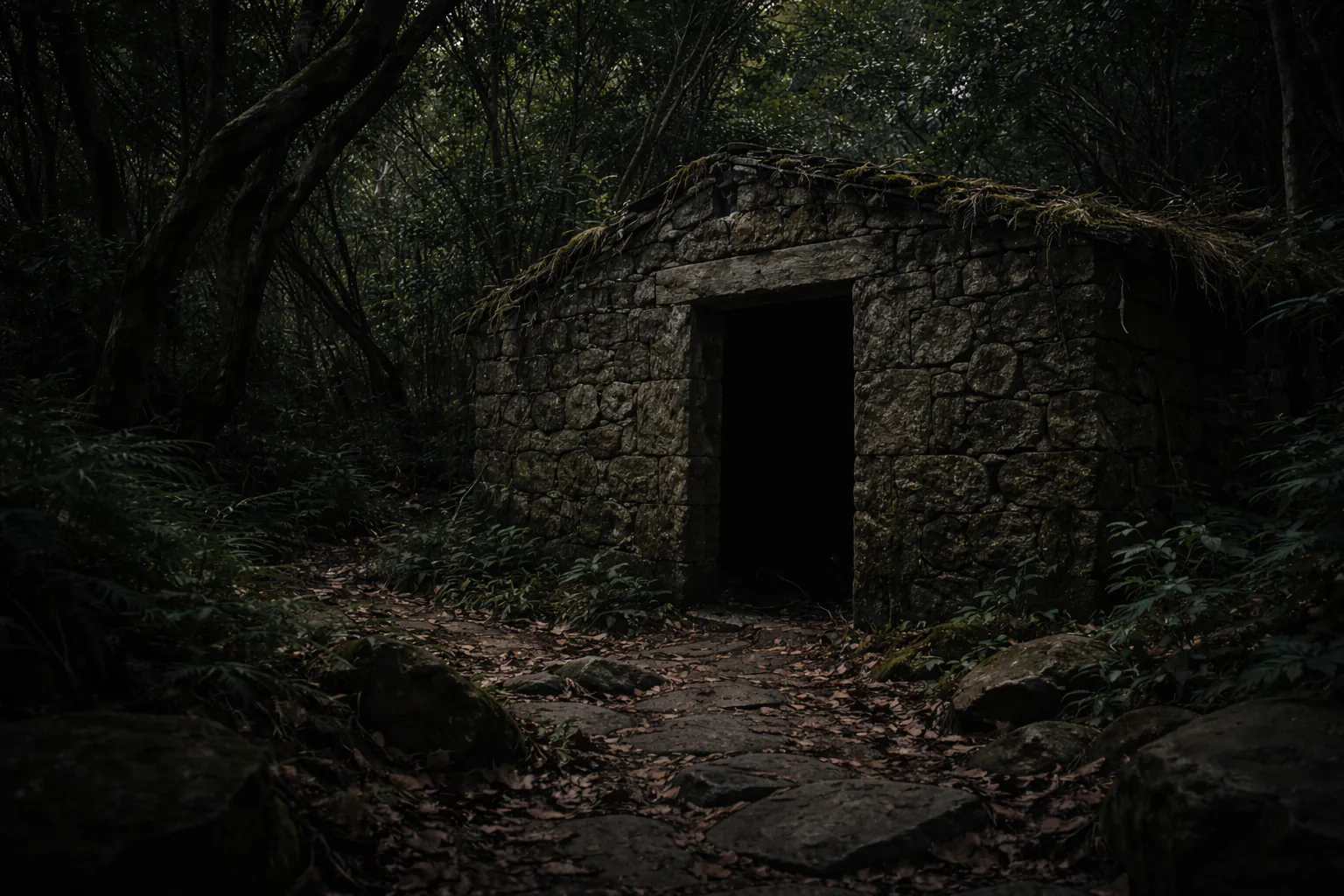
走到一個分岔口時,我們停下來休息,剛好看到一張舊木椅。椅子上坐著一位老人,他背著一個舊帆布袋,眼神深邃而平靜,像是對這片山林極為熟悉。朋友隨口問他:「上面還有什麼風景嗎?」老人微微一笑,語氣淡然地說:「上面沒什麼風景,但有間屋。」我們以為他指的是某種廢棄的石屋,這在香港的山區並不罕見。於是朋友又問:「那裡有人住嗎?」老人搖了搖頭:「沒人住,但屋還在。」他頓了頓補充道:「不過沒有門。」我們帶著些許好奇心繼續上路,越往深處走,樹林越發密集,四周的光線變得昏暗起來。大約走了二十分鐘,朋友突然停下來,指著前方說:「你看!」順著他的手指望去,我們看到樹林間隱隱露出一面石牆。靠近後才發現,那是一間石屋。整座屋子用粗糙的石頭砌成,牆壁上長滿青苔,屋頂已經坍塌了一部分。最奇怪的是門的位置,那裡只有一個空空的門框,既沒有門板,也沒有任何遮擋。門內一片漆黑,無法看清裡面有什麼。朋友開玩笑說:「可能以前有人住吧。」我們湊近看了一下,屋內空蕩蕩的,只有地上散落著一些碎石和枯葉,看起來已經荒廢多年。我拍了一張照片作為紀念,便轉身離開了。然而,這件事並未就此結束。大約半年後的一個晚上,我在行山的群組裡看到一則帖子,有人提到柏架山的那間石屋。發帖的人說,他某天晚上在那裡行山時,遠遠看到樹林裡有燈光。他本以為是有人在露營,但當他靠近時卻發現,石屋裡空無一人,只能看到微弱的燭光閃爍,像是油燈般的光芒。帖子下方的留言眾說紛紜,有人說那是以前看林人的屋子,也有人猜測可能是其他行山客留下的燈光。但其中有一條留言引起了我的注意,那條留言很短,只有一句話:「那間屋本來就沒有門。」看到這句話,我不禁想起了那天見到的石屋以及老人說過的話。「屋還在,但沒有門。」這句話此刻聽來竟有些毛骨悚然。幾天後,我決定再去一次柏架山,親眼確認這件事。這次我選擇在下午出發,希望能趕在天黑前回到安全地帶。我沿著之前的路線找到那間石屋,它依然矗立在樹林深處,孤零零的模樣讓人感到不安。我站在門口向內張望,裡面依舊空無一物,只剩地上的落葉和幾塊散落的碎石。我試圖走進去,但腳步卻猶豫了。那空蕩蕩的門框像是一個無聲的警告,不容侵犯。我退後幾步,在附近坐下休息,四周靜得只聽見風穿過樹葉的聲音。就在我準備起身離開時,一陣微弱的光芒從石屋內閃了一下。我愣住了,那光像是燭火般搖曳不定,但下一秒又消失得無影無蹤。我站在原地不敢動彈,腦中浮現出一個可怕的想法:如果一間屋子沒有門,那麼光是怎麼進去的?人又是怎麼進出的?我突然感覺到背後有一股涼意,一回頭,只見那片密林中似乎有什麼東西在晃動,我不敢再停留,匆匆離開了那裡。直到今天,每當我想起那間石屋,都會感到一陣莫名的不安。或許,有些地方注定不該被打擾,而有些問題,也許永遠不該尋求答案。
English Version
Deep within the quiet slopes of Mount Parker, where the forest thickens and even mobile signals fade into nothing, the hiking trails begin to feel less like paths through nature and more like corridors into another world, a place where sound is softened, light is filtered through layers of leaves, and time itself seems to slow beneath the dense canopy, and it was along one of these winding routes, starting from the direction of Tai Tam Reservoir, that I once set out with a few friends, expecting nothing more than an ordinary day hike, the ground beneath our feet covered in dry leaves that crackled with each step while thin strands of sunlight pierced through the trees in scattered beams, illuminating patches of earth before fading again into shadow, and as we moved deeper into the forest, the atmosphere shifted subtly, the air growing cooler, the silence heavier, until we reached a fork in the path where we decided to pause, and it was there that we noticed an old wooden chair placed slightly off to the side, worn with age yet still intact, and seated upon it was an elderly man carrying a faded canvas bag, his expression calm, almost detached, as though he belonged entirely to that environment, as if he had been there long before us and would remain long after we had gone, and one of my friends casually asked him whether there was anything interesting further up the trail, perhaps a viewpoint or a clearing, and the man responded with a faint smile, saying that there was nothing much to see, only a house, and at first we assumed he meant some abandoned structure, the kind occasionally found in remote parts of Hong Kong’s hills, so we asked if anyone still lived there, and he shook his head slowly, replying that no one lived there anymore, but the house was still there, and then after a brief pause he added something that seemed almost like an afterthought, that the house had no door, and though the remark struck us as odd, it did not deter our curiosity, instead encouraging us to continue further along the trail, wondering what kind of structure could exist without something as fundamental as a door, and as we ventured deeper into the forest, the trees grew denser, their branches intertwining overhead to block out more of the sky, causing the light to dim noticeably, and after about twenty minutes of walking, one of my friends suddenly pointed ahead, drawing our attention to a faint outline partially hidden among the trees, and as we approached, the shape resolved itself into a small stone house, constructed from rough, uneven rocks stacked together in a way that suggested both resilience and age, its walls covered in patches of moss and creeping plants, while part of the roof had already collapsed inward, exposing the interior to the elements, and when we reached the front of the structure, we saw exactly what the old man had described, a doorway that was nothing more than an empty frame, with no door, no hinges, no sign that one had ever existed, just a dark opening leading into a shadowed interior that seemed to absorb the light around it, and despite the eerie impression it gave, we stepped closer, peering inside to find nothing but an empty space scattered with fallen leaves and small stones, the floor uneven and undisturbed, suggesting that the house had long been abandoned, and after taking a few photos and exchanging a few lighthearted comments to mask our unease, we left the place behind and continued our hike, eventually returning home with the experience filed away as little more than an unusual discovery, yet months later, on an otherwise ordinary evening, I came across a post in a hiking group where someone mentioned the same stone house on Mount Parker, describing how they had passed by the area at night and noticed a faint light glowing within the structure, initially assuming it to be a campsite or someone using a lantern, but upon approaching, they found the interior completely empty, with no person present, only the flickering light resembling that of a candle or oil lamp, and while many of the comments attempted to rationalize the sighting, suggesting leftover equipment or reflections, one particular reply stood out for its simplicity, stating only that the house had never had a door to begin with, and reading those words brought back the memory of that elderly man and his quiet statement, that the house was still there but had no door, a detail that now seemed far more significant than it had at the time, and driven by a mixture of curiosity and unease, I decided to return to Mount Parker a few days later, this time going alone and choosing to start in the afternoon so that I could leave before nightfall, retracing the same route through the forest until I once again found the stone house standing in its isolated clearing, unchanged and silent, its presence somehow heavier than I remembered, and as I stood at the entrance, looking into the dark interior, I felt a hesitation that I could not fully explain, as though the empty doorway represented more than just an architectural absence, but a boundary that was not meant to be crossed, and instead of stepping inside, I moved back and sat nearby, listening to the faint sounds of the forest, the rustling leaves, the distant movement of branches in the wind, until just as I was about to leave, a subtle flicker of light appeared within the house, brief and unsteady, like the flame of a candle disturbed by air, and then it vanished just as quickly, leaving the interior once again in darkness, and in that moment a thought formed that sent a chill through me, because if the house truly had no door, no barrier between inside and outside, then the question was not simply how the light appeared, but what it meant for something to exist within a space that was never properly enclosed, never truly separated from the surrounding world, and whether the absence of a door made it less a house and more a threshold, a place where something could enter and leave without restriction, unseen and unaccounted for, and as that realization settled in, I became acutely aware of the forest around me, of the possibility that I was no longer alone in the way I had assumed, prompting me to leave quickly, resisting the urge to look back, and even now, whenever I think of that place, the image that returns most vividly is not the structure itself, but the empty doorway, standing open not as an invitation, but as a quiet warning, suggesting that there are places where the boundaries we rely on do not exist, and that in such places, the difference between inside and outside, presence and absence, may be far more fragile than we are willing to accept