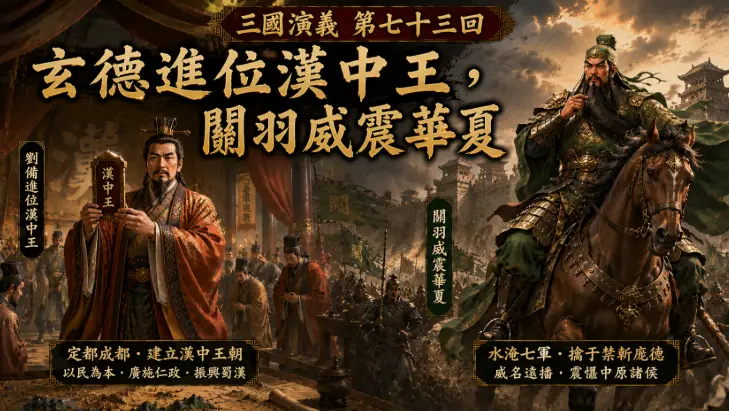
劉備歷經多年征戰,終於在群臣擁戴下進位漢中王,蜀漢勢力正式邁向新的高峰。另一方面,關羽率軍北伐襄樊,以驚人的軍事才能震動天下,水淹七軍、生擒于禁、威震華夏,使曹魏朝野震驚,也令三國局勢迎來重大轉折。
After years of relentless warfare, Liu Bei finally accepted the title of King of Hanzhong, marking a decisive milestone in the rise of Shu. At the same time, Guan Yu launched his famous northern campaign against Fancheng, achieving one astonishing victory after another. His triumphs echoed across China, transforming the balance of power and creating one of the most celebrated chapters in the Romance of the Three Kingdoms.
中文
漢中之戰落下帷幕,蜀軍上下歡聲雷動。曹操退守關中,劉備終於站穩漢中這片戰略要地。諸葛亮、法正、黃權等群臣一致認為,如今曹操已自立魏王,孫權雄據江東,若劉備仍以左將軍自居,既難以號令天下,也無法延續漢室正統。
群臣數次勸進,劉備最初仍堅辭不受。他始終以漢室宗親自許,不願給天下人留下僭越之名。然而眾臣跪地請命,認為唯有建立新的旗幟,才能團結天下忠漢之士。
最終,劉備登壇受印,正式進位漢中王。
旌旗蔽日,百官朝賀,蜀地軍民無不歡欣鼓舞。劉備大封群臣,諸葛亮統理百政,法正參贊軍機,關羽、張飛、馬超、黃忠分掌重兵,蜀漢政權逐漸展現出雄踞一方的氣勢。
就在成都舉國歡慶之時,遠在荊州的關羽卻已披甲上馬。
他望著北方襄樊方向,久久不語。
「今日漢中王已立,吾當北取中原,以報國恩。」
數萬將士齊聲應諾,大軍浩浩蕩蕩直逼樊城。
曹仁據守堅城,深知關羽勇不可當,只能閉門死守,等待援軍。曹操聞訊後,立即命于禁率領七軍南下,又派龐德同行迎敵。
龐德昔日曾效力馬超,如今歸附曹魏。他抬棺出征,立誓若不能斬關羽,絕不生還。
兩軍交鋒,箭如飛蝗,鼓角震天。
龐德勇猛異常,多次與關羽激戰數十回合,不分勝負。一次混戰之中,龐德一箭射中關羽左臂,蜀軍上下大驚。然而關羽包紮傷勢後,依然親自督戰,士氣絲毫未減。
正當雙方相持不下之際,天降暴雨,漢水暴漲。
關羽敏銳察覺天時已至,下令掘開堤壩,引洪水直衝魏軍營寨。
頃刻之間,洪流翻騰,七軍盡沒。
于禁率軍苦守多日,最終無力回天,只得率眾投降。龐德拒絕屈服,即使被擒,依然怒目而立,誓死不降,最終慷慨就義。
消息飛傳天下。
「關羽水淹七軍,生擒于禁!」
朝野震動,四海譁然。
曹操聞報,沉默許久,竟一度萌生遷都避鋒的念頭。群臣紛紛勸阻,認為魏國根基未失,不可因此動搖國本。
此時,各地豪傑皆驚於關羽威名,不少郡縣望風歸附。關羽「威震華夏」四字,自此傳遍天下。
然而,勝利的光芒之下,也逐漸浮現危機。
荊州兵力因北伐而日漸空虛,補給線越拉越長。東吳方面雖表面維持盟約,實則暗中觀察戰局,等待最佳時機。曹魏則積極聯絡孫權,希望聯手削弱關羽。
戰場上的勝利,並未真正終結三國之爭,反而將更大的風暴推向前方。
此刻的關羽仍立於高坡之上,青龍偃月刀映照夕陽,目光直視中原。
他的名字,已成為天下敬畏的傳奇;而命運,也正悄悄翻開下一頁。
English Version
The victory in Hanzhong transformed the destiny of Liu Bei’s kingdom. After forcing Cao Cao to withdraw, Liu Bei secured one of the most strategic regions in China. His advisers, led by Zhuge Liang and Fa Zheng, insisted that the time had come for him to assume a royal title. With Cao Cao already ruling as King of Wei and Sun Quan dominating the southeast, remaining only a general would weaken Liu Bei’s claim as the defender of the Han dynasty.
Although reluctant at first, Liu Bei finally accepted the wishes of his officials and became the King of Hanzhong. The ceremony inspired soldiers and civilians alike, symbolizing the emergence of Shu as a legitimate rival among the three great powers.
While celebrations filled Chengdu, Guan Yu had already turned his attention northward.
His target was Fancheng, one of Wei’s strongest defensive fortresses. Believing that victory there could open the road into central China, Guan Yu personally led his elite army toward the battlefield.
Cao Ren immediately prepared for a desperate defense, refusing to abandon the city despite the overwhelming reputation of his opponent. Cao Cao responded by dispatching Yu Jin with seven armies, accompanied by the fearless Pang De.
Pang De marched with extraordinary determination, reportedly bringing his own coffin as a symbol that he would either defeat Guan Yu or never return alive.
The battles that followed were fierce. Guan Yu and Pang De exchanged powerful attacks, while arrows darkened the skies and war drums echoed across the plains. During one encounter, Pang De wounded Guan Yu with an arrow to the arm. Despite the injury, Guan Yu refused to retreat, inspiring his troops with his unwavering resolve.
Then nature changed everything.
Heavy rain caused the Han River to overflow. Recognizing an extraordinary opportunity, Guan Yu ordered the floodwaters redirected toward Wei’s encampments.
The torrent swept through the seven armies with devastating force.
Entire formations disappeared beneath the rushing waters. Yu Jin, seeing no hope of survival, surrendered with his remaining troops. Pang De refused to yield even after capture, choosing death rather than abandoning his loyalty.
News of the disaster spread rapidly across China.
“Guan Yu has flooded seven armies and captured Yu Jin.”
The victory stunned every kingdom. Even Cao Cao reportedly considered relocating his capital before his advisers convinced him to remain firm. Across the empire, Guan Yu’s reputation reached unprecedented heights, and many local commanders began reconsidering their allegiance.
From this campaign came the famous expression that Guan Yu “shook all under Heaven.”
Yet triumph often hides the seeds of future danger.
As Guan Yu advanced farther north, Jing Province became increasingly exposed. Supply routes stretched across great distances, while Sun Quan quietly observed every development. Behind the scenes, Wei and Wu both recognized that Guan Yu’s growing prestige threatened the balance of power.
The brilliant campaign became one of the greatest military victories in the Romance of the Three Kingdoms, but it also marked the beginning of an even greater conflict that would soon reshape the fate of heroes and kingdoms alike.
Standing beneath the evening sky, Guan Yu gazed toward the northern horizon. His victories had made him a legend, but destiny was already preparing its next and most difficult trial.