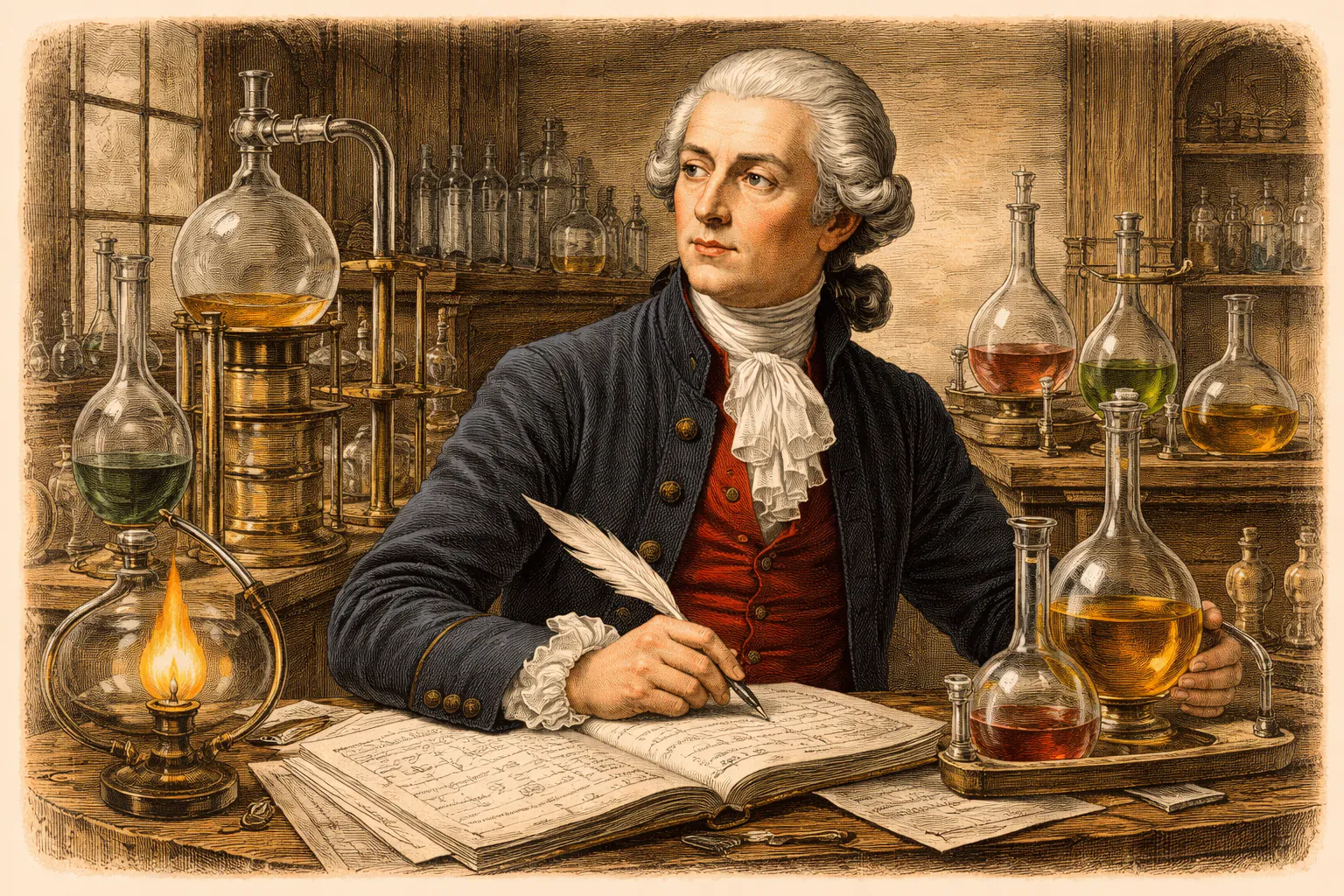
安托萬·拉瓦節(Antoine Lavoisier)是18世紀法國著名化學家,被譽為「現代化學之父」。他透過精確的實驗與量化方法,推翻了當時流行的燃素說,提出燃燒與氧氣有關的理論,並建立「質量守恆定律」,指出化學反應前後物質總質量保持不變。拉瓦節同時改革化學命名法,建立更清晰的科學語言,使化學成為一門現代科學。他的研究徹底改變了人類對物質與化學反應的理解。
Antoine Lavoisier (1743–1794) was a pioneering French chemist widely regarded as the “Father of Modern Chemistry.” He transformed chemistry from a speculative discipline into a precise scientific field through careful experimentation and quantitative measurement. Lavoisier is best known for establishing the law of conservation of mass and for identifying oxygen’s role in combustion, effectively disproving the outdated phlogiston theory. He also helped develop modern chemical nomenclature, bringing clarity and structure to the science. Despite his immense contributions, Lavoisier’s life ended tragically during the French Revolution. His legacy, however, endures as a cornerstone of modern scientific thought and methodology.
在人類科學史上,化學從神秘的煉金術逐漸發展為一門嚴謹的科學,而這一轉變的重要人物之一便是安托萬·拉瓦節。他的研究不僅推翻舊有理論,也建立了現代化學的基礎,因此被後世尊稱為「現代化學之父」。
拉瓦節於1743年出生於法國巴黎的一個富裕家庭。他的父親是一名律師,家庭條件優渥,使他能夠接受良好的教育。年輕時的拉瓦節在巴黎接受人文與科學教育,並對自然科學產生濃厚興趣。
最初,他依照家庭期望學習法律並取得律師資格,但他的真正興趣仍然在科學研究上。很快,他便投入化學與自然科學的研究,並開始進行一系列實驗。
在18世紀初期,化學理論仍然受到一種稱為「燃素說」的觀念影響。根據這一理論,所有可燃物質都含有一種稱為「燃素」的物質,在燃燒時釋放出來。這一理論在當時被許多科學家接受。
然而拉瓦節透過精確測量與實驗,開始對燃素說產生懷疑。他注意到某些金屬在燃燒後重量反而增加,而不是減少。如果燃燒是釋放燃素,那麼物質的重量應該減少才對。
為了解釋這一現象,拉瓦節進行大量實驗。他使用密閉容器進行化學反應,並仔細測量反應前後的重量。透過這些實驗,他發現燃燒實際上是物質與空氣中某種成分結合的過程。
這種成分後來被稱為氧氣。拉瓦節證明,當物質燃燒時,它會與氧氣結合形成新的化合物,因此重量會增加。
這一發現徹底推翻了燃素說,並建立新的燃燒理論。這也標誌著化學從傳統理論轉向以實驗為基礎的現代科學。
在研究過程中,拉瓦節還提出一個重要原則:在化學反應中,物質的總質量保持不變。這一原則被稱為「質量守恆定律」。
這一定律指出,在封閉系統中,化學反應前後所有物質的質量總和相同。換句話說,物質不會憑空產生或消失,而只是以不同形式存在。
質量守恆定律成為化學與物理學的重要基礎,對後來的科學研究具有深遠影響。
除了理論研究之外,拉瓦節也致力於建立更清晰的化學語言。在18世紀之前,化學物質的名稱往往混亂且缺乏統一標準。
拉瓦節與其他科學家合作,建立新的化學命名系統,使化學名稱能夠反映物質的組成。例如「氧化物」、「硫酸」等名稱,都來自這一時期的命名改革。
這套命名方法使化學研究更加清晰與系統化,也促進科學知識的交流與傳播。
1789年,拉瓦節出版重要著作《化學基礎論》。這本書被視為第一本現代化學教科書,其中整理了他的理論與實驗成果。
在書中,他列出當時已知的化學元素,並提出新的化學研究方法。這本書對化學教育與研究產生重大影響。
然而拉瓦節的生活並不只限於科學。他同時也參與政府與經濟管理工作,曾在法國稅務系統中擔任職務。這一角色在後來的政治動盪中成為不利因素。
1789年,法國大革命爆發。革命期間,許多與舊制度有關的人物受到審判。拉瓦節因為曾參與稅務機構而被指控與舊政權有關。
1794年,拉瓦節被革命法庭判處死刑並被送上斷頭台。據說在審判過程中,有人請求延緩處決,以便讓他完成科學研究,但法官回答:「共和國不需要科學家。」
這一事件成為科學史上的悲劇之一。拉瓦節去世時只有50歲,許多研究工作尚未完成。
儘管他的生命過早結束,但他的科學貢獻卻長久流傳。後來的化學家普遍認為,他的研究標誌著化學革命的開始。
在現代化學中,精確測量與實驗方法仍然是研究的重要基礎,而這正是拉瓦節所強調的科學精神。
今天,人類對化學反應、元素與分子結構的理解已經大幅進步,但許多基本原理仍然源自拉瓦節的研究。
他不僅推翻舊理論,也建立新的科學方法,使化學成為一門以實驗與數據為基礎的學科。
正因如此,安托萬·拉瓦節被視為科學史上最重要的化學家之一。他的工作不僅改變化學,也為現代科學奠定重要基礎。
從煉金術到現代化學,這一巨大的轉變背後,正是像拉瓦節這樣的科學家所做出的努力。他讓人類第一次真正理解燃燒、元素與物質變化的本質。
English Version
Antoine Lavoisier stands as one of the most transformative figures in the history of science, a man whose work redefined chemistry and elevated it into a modern, quantitative discipline. Born in Paris in 1743 into a wealthy family, Lavoisier received an excellent education, initially studying law as expected of his social class. However, his passion for science soon became evident, and he devoted himself to the study of natural philosophy, particularly chemistry, which at the time was still intertwined with alchemy and lacked rigorous experimental foundations.
In the mid-18th century, chemistry was dominated by the phlogiston theory, which proposed that a substance called “phlogiston” was released during combustion. This theory, though widely accepted, was fundamentally flawed. Lavoisier approached the subject with a new perspective, emphasizing precise measurement and systematic experimentation. By carefully weighing substances before and after chemical reactions, he demonstrated that mass is conserved—a principle now known as the law of conservation of mass. This insight marked a turning point, establishing that matter is neither created nor destroyed in chemical processes.
One of Lavoisier’s most significant achievements was his identification of oxygen and its role in combustion and respiration. Through meticulous experiments, he showed that combustion is not the release of phlogiston but rather a chemical reaction involving oxygen. This discovery not only dismantled the phlogiston theory but also provided a coherent explanation for a wide range of chemical phenomena. Lavoisier also named oxygen and hydrogen, contributing to the development of a standardized chemical language.
Lavoisier’s commitment to clarity and precision extended beyond experimentation to the language of chemistry itself. Alongside collaborators such as Claude-Louis Berthollet and Antoine François de Fourcroy, he developed a new system of chemical nomenclature. This system replaced vague and inconsistent terminology with a logical structure based on composition and properties, enabling scientists to communicate more effectively and advance the field more rapidly.
In 1789, Lavoisier published his landmark work, Traité Élémentaire de Chimie (Elementary Treatise of Chemistry), which is often considered the first modern chemistry textbook. In this work, he presented a systematic overview of chemical knowledge, including a list of elements based on experimental evidence. His approach emphasized observation, measurement, and reproducibility, setting new standards for scientific inquiry.
Beyond his scientific work, Lavoisier played an active role in public service. He was involved in improving agricultural practices, studying public health issues, and contributing to the reform of France’s financial system. He also worked on the development of the metric system, which sought to standardize measurements across the nation. However, his involvement in tax collection as a member of the Ferme Générale would later have dire consequences.
The outbreak of the French Revolution brought dramatic changes to French society, and Lavoisier’s association with the old financial system made him a target. Despite his scientific achievements, he was arrested, tried, and ultimately executed by guillotine in 1794 during the Reign of Terror. His death is often cited as one of the greatest tragedies in the history of science. The mathematician Joseph-Louis Lagrange famously remarked that it took only a moment to cut off his head, but perhaps a century would not suffice to produce another like him.
Lavoisier’s legacy is profound and enduring. By introducing quantitative methods and emphasizing empirical evidence, he transformed chemistry into a rigorous science. His work laid the foundation for future discoveries in chemical reactions, thermodynamics, and molecular theory. Today, the principles he established remain central to scientific practice, influencing not only chemistry but also other fields that rely on precise measurement and experimentation.
What makes Lavoisier particularly remarkable is his ability to challenge established ideas and replace them with a more accurate and systematic understanding of the natural world. His insistence on measurement and clarity helped shift science away from speculation and toward a disciplined methodology that continues to define modern research.
In many respects, Antoine Lavoisier did not merely contribute to chemistry—he reinvented it. His work marks the transition from alchemy to modern science, a transformation that has had lasting implications for technology, industry, and our understanding of the material world. Even in the face of political upheaval and personal tragedy, his scientific achievements continue to illuminate the path of discovery, making him one of the most important figures in the history of human knowledge.