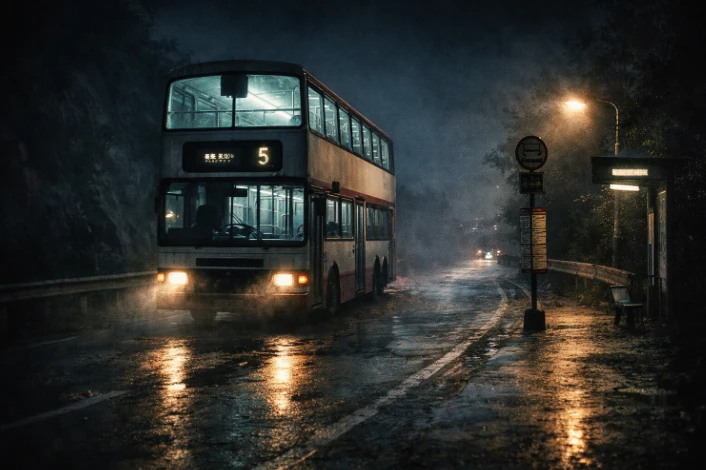
在香港眾多靈異都市傳說之中,「薄扶林道鬼巴士」一直是一個令人不寒而慄的故事。這個傳聞多年來在港島西一帶流傳,特別是在夜班司機與巴士迷之間,常被提起。有人說,在深夜的薄扶林道上,偶爾會看見一輛不應該出現的巴士。
薄扶林道位於香港島西部,連接西營盤、香港大學、薄扶林與香港仔。這條道路沿山而建,一邊是斜坡山林,一邊俯瞰港島西面的海岸。白天時車流繁忙,但到了深夜,整條道路會變得十分安靜。
也正是這種幽靜的環境,使得不少神秘故事在這條路上誕生。
據說在上世紀六、七十年代,薄扶林道曾發生過一宗嚴重交通意外。一輛載滿乘客的巴士在夜間行駛時,疑似因煞車失靈,在彎道失控衝出道路。事故造成多人傷亡,當時震動整個香港社會。
這宗意外之後,附近居民開始流傳一個奇怪的說法:在某些深夜時刻,會看見一輛舊式巴士再次出現在薄扶林道。
最早講述這個故事的,是一些夜班巴士司機。有人表示,在凌晨時分駛經某些巴士站時,曾看見遠處出現一輛巴士。那輛車的外型像是舊式雙層巴士,車身燈光微弱,看起來十分老舊。
奇怪的是,這輛巴士並不屬於任何正常路線。
據說它會像普通巴士一樣慢慢駛近巴士站,甚至會停下來。車門似乎會打開,但車上卻看不見乘客上落。
有些人說,當巴士停下來時,可以透過車窗看到車內坐滿人影。但那些乘客都靜靜地坐著,一動不動,臉色蒼白,看起來像沒有生命。
也有人說,整輛巴士其實是空的。車廂裡沒有任何人,只剩下昏暗的燈光與空蕩蕩的座位。
更令人感到詭異的是,當有人想看清楚車牌或路線牌時,那輛巴士往往會在短短幾秒之內消失。
其中一個流傳較廣的故事,來自一名夜班的士司機。據說某晚凌晨,他在薄扶林道附近接載一名乘客前往香港仔。
當車子經過一個巴士站時,他發現站內竟然停著一輛舊式雙層巴士。那輛車看起來非常古老,像是幾十年前的型號。
司機感到奇怪,因為那個時間並沒有任何巴士路線會經過那個站。
他放慢車速,從旁邊駛過。就在那一瞬間,他透過車窗看到車內坐著很多人。
但那些人全都面無表情地坐著,眼神空洞。整個車廂非常安靜,沒有任何聲音。
更可怕的是,當他再看第二眼時,整輛巴士竟然不見了。
那名司機嚇得加速離開。後來他把這件事告訴同行,但很多人只是半信半疑。
除了司機之外,也有一些夜歸的行人說自己見過奇怪的巴士。有些人表示,在某些深夜巴士站會突然出現車燈。遠遠看去像是巴士靠站,但當他們走近時,卻什麼都沒有。
也有人說,曾經看到一輛舊巴士在路上慢慢行駛,但當車子轉過彎道後,就再也找不到它的蹤影。
當然,對於這些故事,也有不少理性的解釋。有人認為,深夜光線昏暗,加上薄扶林道多彎,遠處車燈容易造成錯覺。有時候遠方巴士的燈光反射在樹林或山壁上,也可能讓人誤以為出現另一輛車。
此外,香港人對靈異故事一直十分熱衷。許多都市傳說往往在口耳相傳之中逐漸被渲染,使得故事變得更加神秘。
然而即使如此,「薄扶林道鬼巴士」的傳聞仍然歷久不衰。每隔一段時間,就會有人重新提起這個故事。
或許真正讓人著迷的,並不是是否真的存在鬼巴士,而是那種深夜道路上的神秘氣氛。
當城市的燈光逐漸熄滅,街道變得空無一人時,人們的想像力往往會變得更加敏感。任何遠處的燈光與聲音,都可能被解讀成奇怪的存在。
今天的薄扶林道依然是港島重要的交通道路之一。每天都有大量車輛經過,學生、居民與遊客穿梭其中。
但當夜深人靜時,如果你獨自站在某個巴士站,也許會突然看見遠方出現兩道車燈。
那輛巴士正慢慢駛近,看起來像要停站。
但當它靠近時,你或許會發現一件奇怪的事情。
車內,似乎沒有任何活人。
English Version
Among the many urban legends whispered across Hong Kong Island, the story of the ghost bus said to appear along Pok Fu Lam Road remains one of the most enduring, passed quietly between night-shift drivers, transport workers, and those who have spent enough time on the road to know that certain places feel different after midnight, when traffic fades and the city’s constant motion slows into something more uncertain, leaving long stretches of road wrapped in silence where even distant headlights seem to carry an unusual weight the legend traces back to an accident said to have occurred decades ago, when a double-decker bus traveling along the winding hillside route lost control at night and plunged off the road, resulting in multiple fatalities and leaving behind not only a tragic memory but, according to some, a lingering presence that refuses to fade, replaying itself in fragments that occasionally surface in the quietest hours; drivers who recount the experience often describe it beginning with a distant set of headlights approaching a bus stop at a time when no scheduled routes should be running, the vehicle emerging slowly from the darkness, its shape unmistakably that of an old-style double-decker, its exterior dimly lit and its movement steady yet oddly detached from the normal rhythm of traffic, and as it pulls into the stop, everything appears routine at first glance—the doors seem to open, the engine idles—but something is wrong, something that becomes apparent only upon closer inspection, because there are no passengers boarding, no footsteps, no voices, only a stillness that feels too complete to be natural; some witnesses claim that when they dared to look through the windows, they saw rows of seated figures inside, motionless and silent, their faces pale and indistinct, as if frozen in time, while others insist that the bus was entirely empty, its interior illuminated just enough to reveal vacant seats stretching into darkness, creating an impression that was somehow more unsettling than the presence of figures, as though the absence itself carried meaning; one of the most frequently told accounts comes from a taxi driver who, while transporting a passenger late at night toward Aberdeen, noticed such a bus waiting at a stop along the road, its design clearly belonging to an earlier era, something that should no longer have been in service, and driven by curiosity, he slowed as he passed, glancing toward the upper deck where he thought he saw silhouettes seated in unnatural stillness, yet before he could confirm what he had seen, the bus disappeared entirely, leaving behind an empty stretch of road that offered no explanation for its presence or its sudden absence; similar stories have been reported by pedestrians returning home late, who describe seeing lights approaching what appears to be a bus stop, only for the vehicle to vanish as they draw closer, as if it exists only at a distance or only for a moment, never long enough to be fully observed, reinforcing the sense that it operates outside the normal flow of time; skeptics, of course, attribute these sightings to visual illusions caused by winding roads, reflections of distant vehicles, or the effects of fatigue on late-night perception, and such explanations are not without merit, especially given the way light behaves unpredictably in low-visibility conditions, yet the persistence of the legend suggests that something deeper resonates within it, not necessarily proof of the supernatural but an expression of how memory, environment, and imagination can intertwine to create experiences that feel real even when they cannot be easily verified; today, Pok Fu Lam Road remains a vital route connecting areas such as Sai Ying Pun, the University of Hong Kong, Pok Fu Lam, and Aberdeen, busy and familiar during the day, yet when night falls and the flow of traffic diminishes, the road takes on a quieter, more introspective quality, one that invites awareness of small details—the echo of tires on asphalt, the flicker of distant lights, the subtle movement of shadows along the hillside—and it is in these moments, when the mind becomes more receptive to suggestion, that the legend finds its space, lingering at the edges of perception, waiting to be noticed; perhaps the ghost bus is nothing more than a story shaped by tragedy and retold through generations, or perhaps it represents something else entirely, a fragment of an event that continues to echo in ways we do not fully understand, appearing only under certain conditions, visible only to those who happen to be in the right place at the right time, and disappearing before it can be explained; whatever the truth may be, the story endures, carried forward not by proof but by experience, by the quiet hesitation of drivers who, when passing a bus stop in the early hours, might glance twice at a distant pair of headlights approaching too slowly, too deliberately, and wonder—if only for a moment—whether the bus that seems to be arriving is part of the present, or something that has been traveling that same road for far longer than anyone realizes, stopping night after night at stations where no passengers wait, continuing a journey that was never meant to end.