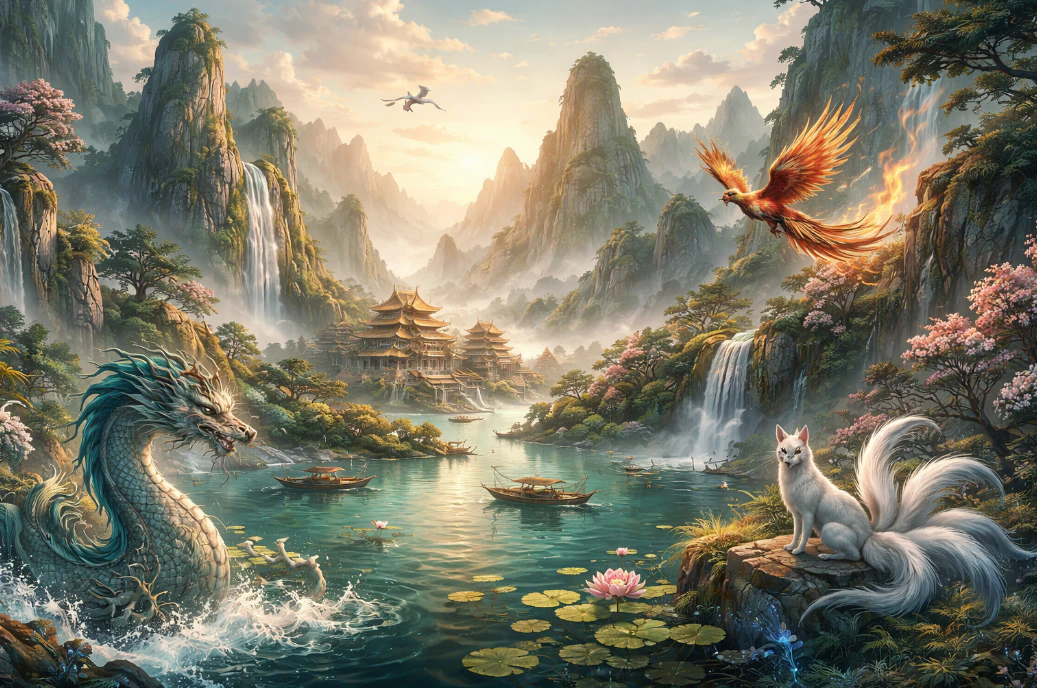
赤水之北,是《山海經》中一片充滿未知與危險的邊境地帶,象徵人類世界之外的混沌空間。這裡聚集奇異生物與詭譎景象,既令人恐懼,也引發探索欲望。赤水作為界線,劃分了秩序與混亂、已知與未知。本文將解析這片神秘地域的象徵意義,以及它如何反映古人對邊界與異界的理解。
North of the Red River is a mysterious and dangerous frontier in Shan Hai Jing, representing the chaotic unknown beyond the human world. Filled with strange creatures and unsettling landscapes, it inspires both fear and curiosity. The Red River serves as a boundary between order and chaos, the known and the unknown. This article explores its symbolic meaning and cultural significance.
在《山海經》的世界觀中,地理不僅是空間的描述,更是一種對秩序與邊界的劃分,而「赤水之北」正是這種劃分最鮮明的象徵之一。赤水本身帶有強烈的意象色彩,「赤」象徵血、火與危險,使這條河流不僅是一道自然界線,更是一條心理與文化上的分界線。在其以北的世界,常被描繪為異常、混亂且難以理解的空間,聚集了各種奇異生物與不合常理的現象。這些描述並非單純的幻想,而是古人對未知地域的投射與想像。在赤水之北,生物的形態往往突破常規,例如人面獸身、異形多足,甚至具備特殊能力的存在,這些形象反映出對自然界未知力量的敬畏與恐懼。同時,這片土地的環境也常被描寫為極端,例如荒涼、灼熱或充滿毒氣,使其成為一個不適合人類生存的空間。從象徵角度來看,赤水之北並不僅僅是地理上的遠方,它更像是一個「邊界空間」,一個介於秩序與混沌之間的過渡地帶。在這裡,既有可能出現威脅,也蘊藏著未知的力量與資源。這種雙重性使得赤水之北成為探索與恐懼並存的象徵。古人透過這樣的敘述,將無法理解的自然現象與遙遠地區的傳聞整合為一個神話體系,使世界在敘事上變得完整。在文化層面上,赤水之北也可被視為一種「他者空間」,它代表著與自身文化不同的存在,無論是異族、異獸,還是異於常理的規則。這種他者化的描寫,一方面強化了中心世界的秩序感,另一方面也反映出人類對未知的複雜態度——既排斥,又渴望理解。在現代語境中,赤水之北可以被解讀為一種心理或文明的邊界,它象徵著當人類面對未知時所產生的不安與想像,同時也提醒我們,所有已知的秩序,都是在與未知的對峙中建立起來的。《山海經》透過這樣的邊境描寫,不僅描繪了一個奇幻世界,也揭示了人類如何理解世界邊界與自身位置的方式。
English Version
In the cosmological framework of Shan Hai Jing, geography is never merely about physical space; it is a way of defining order and boundaries. “North of the Red River” stands as one of the clearest expressions of this idea. The Red River itself carries strong symbolic meaning, with the color red evoking blood, fire, and danger. It functions not only as a natural boundary but also as a cultural and psychological divide. Beyond it lies a realm described as chaotic, strange, and difficult to comprehend. This region is populated by bizarre creatures whose forms defy conventional logic—beings that combine human and animal features, possess unusual numbers of limbs, or exhibit supernatural abilities. These depictions are not random fantasies but narrative attempts to represent the unknown. The environment of this northern land is equally extreme, often portrayed as hostile and uninhabitable, reinforcing its status as a space beyond human control. Symbolically, the area north of the Red River can be understood as a liminal zone, a threshold between order and chaos. It is a place where the rules of the familiar world no longer apply, and where both danger and possibility coexist. This dual nature makes it a powerful metaphor for exploration and fear. By constructing such regions, ancient storytellers were able to incorporate fragmented knowledge, rumors, and observations about distant lands into a coherent worldview. On a cultural level, this territory also represents the concept of the “other.” It embodies everything that lies outside the norms of one’s own society—foreign peoples, unfamiliar creatures, and alternative systems of existence. This portrayal both reinforces a sense of internal order and reveals a deep curiosity about what lies beyond it. In a modern interpretation, the land north of the Red River can be seen as a metaphorical boundary of human understanding, representing the tension between knowledge and uncertainty. It reminds us that every structured system is defined in relation to what it excludes or cannot explain. Through such mythic landscapes, Shan Hai Jing offers insight into how early civilizations conceptualized the edges of their world and their place within it.