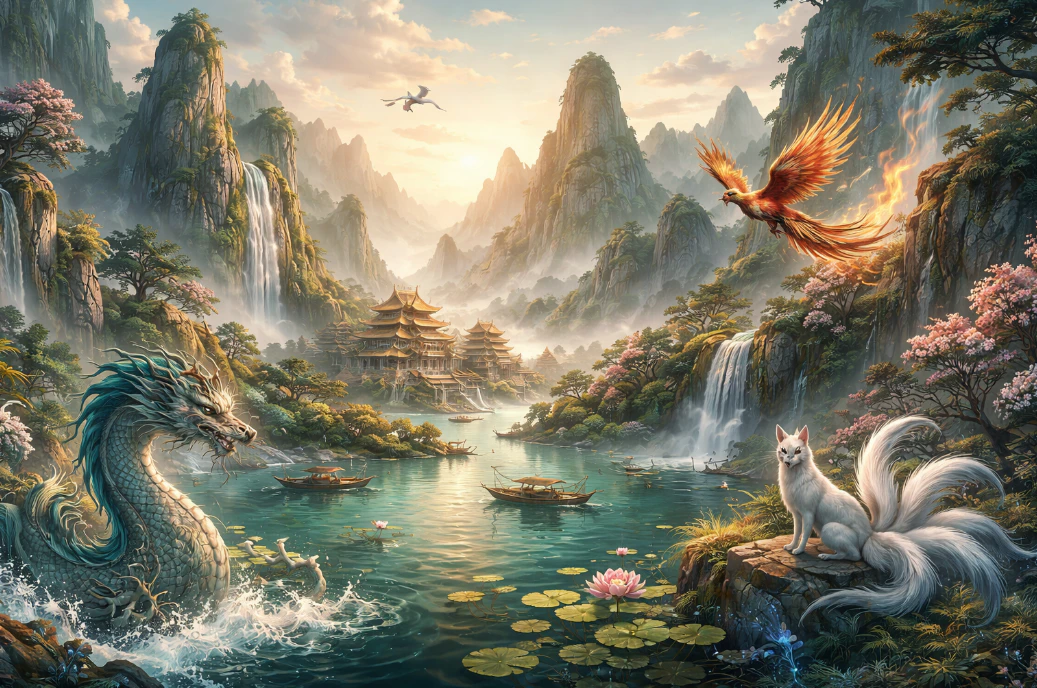
山與海構成古人世界邊界,是地理也是想像。
Mountains and seas marked the limits of the ancient world—both real and imagined.
在古代中國的世界觀中,山與海不只是自然景觀,更是構成世界邊界的基本單位,而《山海經》正是這種觀念最具代表性的文本之一,在這部古籍中,世界並非以經緯度或精確距離來衡量,而是透過一層層山脈與海域的延伸來被理解,山代表已知與可居之地,是資源與秩序的象徵,而海則象徵未知與危險,是超越人類控制的領域,這種「山內為人間,海外為異域」的思維方式,構成了古人對世界邊界的基本想像。從《山海經》的記載可以看到,山並不是單純的地形,而是一種帶有功能性的空間,每一座山都可能蘊藏礦產、草藥或神祇,甚至有守護的神獸存在,這些山脈串連成一種秩序化的地理系統,讓人可以理解世界的結構,而當山的秩序逐漸消失,海便開始出現,海在文本中往往不是單一的水域,而是一種象徵邊界的概念,它代表著一種過渡,一旦跨越,便進入了另一種規則與存在形式的世界,在這些海域之外,存在著各種奇異國度與生物,例如長生不死之民、形體怪異的族群,甚至是與人類完全不同的生命形態,這些描述並非純粹幻想,而可能源自於古人對遠方民族與未知地區的片面理解與誇張詮釋。值得注意的是,古人並不將世界視為一個封閉的球體,而是一種向外擴展的結構,中心是熟悉的文明區域,越往外則越陌生與不可預測,這種結構讓「邊界」不再是一條明確的線,而是一個逐漸變異的區域,在這個過程中,真實與幻想交錯,地理與神話融合,使得世界邊界變成一種流動的概念,而非固定的界線。此外,山與海的對比也反映了古人對秩序與混沌的理解,山象徵穩定與可掌握,而海則象徵變化與不可控,這種二元對立不僅存在於地理描述中,也滲透到文化與思想層面,影響了後世對「內」與「外」、「文明」與「異域」的區分方式。隨著歷史發展,這種以山海為界的世界觀逐漸被更精確的地理知識取代,但它所承載的想像力與象徵意義並未消失,反而在文學、藝術與民間信仰中持續延續,成為東亞文化中理解世界的重要隱喻,因此,當我們重新閱讀《山海經》時,看到的不只是奇異的神獸與荒誕的故事,而是一種古人試圖界定世界邊界的思維方式,在山與海之間,他們不僅描繪地理,也描繪了人類面對未知時的恐懼、好奇與想像。
English Version
In ancient Chinese thought, mountains and seas were not merely physical features but fundamental markers that defined the boundaries of the world, and this perspective is most vividly preserved in the text of Shan Hai Jing, where geography is not measured through coordinates or distances but through a layered progression of landscapes that move from the familiar to the unknown, with mountains representing the realm of human habitation, order, and resources, while seas symbolize transition, uncertainty, and the limits of human understanding, creating a worldview in which the known world exists within mountains and everything beyond the seas becomes a domain of transformation and strangeness. In this system, mountains are not passive terrain but active spaces filled with meaning, often associated with minerals, medicinal plants, divine beings, and guardian creatures, forming a structured and almost navigable mental map that organizes the human world, yet as this structured landscape fades, the sea emerges not simply as water but as a conceptual boundary, a threshold that, once crossed, leads into regions governed by different rules and populated by extraordinary beings, including immortal peoples, hybrid creatures, and societies that defy familiar norms, which may reflect distorted encounters with distant cultures or imaginative interpretations of unexplored territories rather than pure fantasy. Unlike the modern conception of a closed, spherical Earth, the ancient worldview implied in Shan Hai Jing is expansive and center-oriented, with a stable cultural core gradually dissolving into uncertainty as one moves outward, making the idea of a boundary less of a fixed line and more of a shifting zone where reality blends with myth, and this fluid boundary reveals a deeper philosophical structure in which mountains and seas embody a duality between order and chaos, stability and unpredictability, control and the unknown, a contrast that influenced not only geographical thinking but also cultural distinctions between the civilized center and the foreign periphery. Although later developments in cartography and science replaced this symbolic system with more precise representations of the world, the imaginative framework of mountains and seas did not disappear, instead continuing to shape literature, art, and cultural identity, and today, revisiting Shan Hai Jing allows us to see beyond its fantastical imagery and recognize it as a profound attempt to map the limits of human knowledge, where the boundary of the world is not simply a physical edge but a reflection of how people understand and confront the unknown, and in the space between mountains and seas, we glimpse an ancient effort to give form to the infinite.