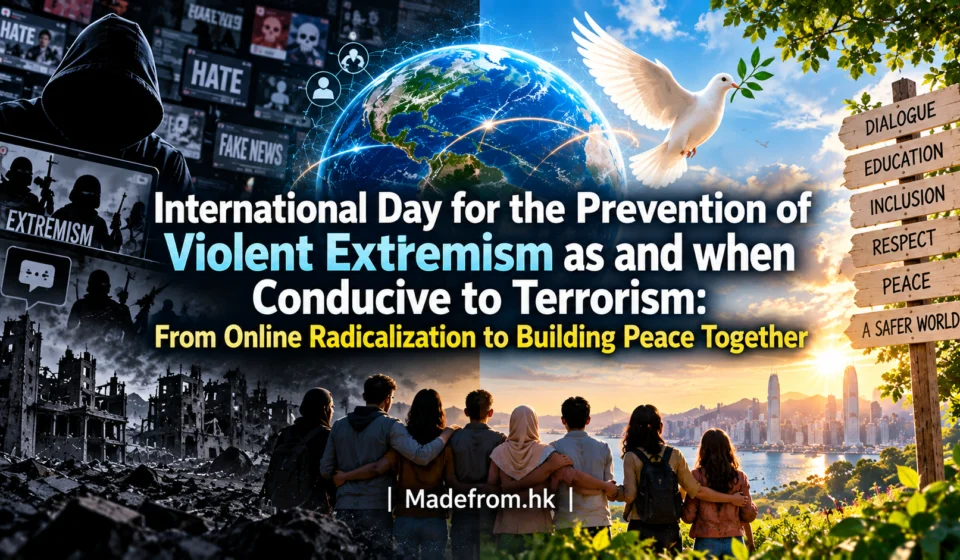
International Day for the Prevention of Violent Extremism as and when Conducive to Terrorism: From Online Radicalization to Building Peace Together
Every February 12, the world reflects on violent extremism and the conditions that can allow terrorism to grow, with prevention built around education, dialogue, human rights and cooperation.
Every year on February 12, the United Nations observes the International Day for the Prevention of Violent Extremism as and when Conducive to Terrorism, an international observance created to increase awareness of violent extremism and strengthen global cooperation to prevent conditions that may contribute to terrorism. The day was established by the United Nations General Assembly through resolution 77/243 in December 2022, reflecting a broader understanding that preventing terrorism requires more than responding to violence after it occurs. Violent extremism is a complex phenomenon that does not belong to any single country, nationality, religion, culture or community. It can emerge in very different social environments, and when extremist ideas become connected with terrorism, the consequences can reach far beyond individual acts of violence. Peace and security can be weakened, human rights can be threatened, communities can become divided and sustainable development can be disrupted. For this reason, the United Nations stresses that terrorism and violent extremism conducive to terrorism must never be associated with an entire religion, nationality, civilization or ethnic group. This principle matters because prevention should not create new prejudice while trying to confront an existing threat. Preventing violent extremism therefore begins long before an act of terrorism takes place. The international approach increasingly looks at the circumstances that may make people vulnerable to radicalization, including exclusion, marginalization, inequality, limited educational opportunities, grievances, perceived injustice and a lack of trust between communities. In 2016, the United Nations Secretary-General presented the Plan of Action to Prevent Violent Extremism, calling for a comprehensive approach that combines necessary security measures with systematic preventive efforts. The plan included more than 70 recommendations and emphasized the need to address conditions that can encourage people to become radicalized or join violent extremist groups. Education is one of the most important parts of that preventive approach. A strong education system does more than provide academic knowledge. It can help people develop critical thinking, understand different cultures, recognize hate speech and misinformation, and communicate with others when disagreements arise. Young people who are able to question information, encounter diverse perspectives and participate meaningfully in their communities may be better equipped to resist narratives that attempt to turn frustration or isolation into hatred and violence. UNESCO has also highlighted education, intercultural dialogue, countering hate speech, and combating racism and discrimination as important elements in preventing violent extremism. The digital environment has added a new dimension to this challenge. The internet has made it possible for people to communicate across borders almost instantly, creating enormous opportunities for education, creativity and community building. At the same time, terrorist and extremist actors can exploit online platforms and digital tools to distribute harmful narratives, spread misinformation, promote hatred, recruit supporters and encourage radicalization. Social media, online communities, gaming environments and emerging technologies have therefore become increasingly important parts of the prevention discussion. The 2026 International Day places particular emphasis on this changing technological landscape under the theme “Preventing Violent Extremism in the Age of New and Emerging Technologies.” Artificial intelligence is especially significant because it can be used in very different ways. Responsible AI systems may help researchers and institutions identify harmful narratives, understand online trends and support prevention programmes. Yet the same technologies can also be misused to generate misleading material, amplify hateful messages, spread extremist narratives and make online recruitment more efficient. The challenge, therefore, is not simply whether technology should be used, but how it can be governed responsibly while protecting human rights, privacy, freedom of expression and the rule of law. In 2026, the United Nations specifically brought together experts and stakeholders to examine the relationship between artificial intelligence and preventing and countering violent extremism, emphasizing responsible, accountable and human-rights-based approaches. Preventing violent extremism also requires cooperation far beyond governments. States and national institutions have primary responsibility for countering terrorism, but international organizations, civil society, universities, religious leaders, journalists, technology companies, private businesses and local communities all have roles to play. The media, for example, has a difficult responsibility. Reporting on terrorism is necessary, but coverage can unintentionally amplify extremist propaganda if violent imagery, slogans or recruitment messages are repeatedly presented without sufficient context. Responsible journalism should inform the public without becoming an advertising channel for those seeking attention through violence. Technology companies face a similar challenge. Online safety cannot be solved simply by deleting content. Effective prevention requires a combination of platform responsibility, digital literacy, education, community engagement, transparency and appropriate safeguards. Human rights must remain at the centre of these efforts. A society cannot create lasting security by treating entire groups of people as threats because of their religion, ethnicity, nationality or cultural background. Such approaches can deepen mistrust, increase discrimination and create exactly the social divisions that extremist movements may exploit. The United Nations therefore emphasizes inclusive, human-rights-based, gender-responsive and community-led approaches to prevention. The International Day is also a reminder that peace means more than the absence of war. Stable societies depend on people having opportunities to learn, participate, speak, seek justice and build meaningful relationships with others. When young people are heard, when communities are given space to address grievances peacefully, and when different cultures and beliefs can meet through dialogue rather than hostility, violent extremism has fewer opportunities to gain influence. This becomes even more important as artificial intelligence and digital technologies transform the way people communicate and understand the world. Technology can bring people together, but it can also allow hatred and misinformation to cross borders at unprecedented speed. The direction of that transformation depends not only on the technology itself, but on the values, rules, institutions and choices surrounding it. The International Day for the Prevention of Violent Extremism as and when Conducive to Terrorism therefore carries a message that extends beyond counter-terrorism. It reminds governments, communities, educators, technology companies, journalists and individuals that prevention is a shared responsibility. Security matters, but lasting security also requires trust, inclusion, education, dialogue and respect for human rights. The strongest defence against violent extremism is not created overnight. It is built gradually through resilient communities, informed citizens, responsible technology and opportunities for peaceful participation. When societies address grievances without turning them into hatred, encourage dialogue instead of division, and protect human rights while confronting violence, extremist movements find fewer places in which to take root. The goal is not simply to respond to terrorism after lives have been harmed. It is to create social conditions in which violence has less opportunity to become an answer to frustration, fear or conflict. In an increasingly connected world, preventing violent extremism is ultimately about building communities where people have reasons to belong, reasons to trust one another and peaceful ways to resolve their differences. That is the deeper message of February 12: peace requires continuous work, prevention requires long-term commitment, and international cooperation remains essential if future generations are to inherit a safer, more inclusive and more resilient world.
The International Day reminds us that preventing violent extremism requires more than security measures. Education, dialogue, human rights, responsible technology and resilient communities must work together to reduce the conditions in which extremism can grow.