漢中失利之後,曹操首次面臨進退兩難。一次隨口說出的「雞肋」,竟洩露全軍撤退之意,也成為三國最著名的典故之一。
After the setback at Hanzhong, Cao Cao faced one of his most difficult decisions. A casual remark about a “chicken rib” unexpectedly revealed his true intentions and became one of the most famous idioms in Chinese history.
中文
定軍山一戰結束後,漢中的天空依舊陰沉。
風吹過群山,也吹散了魏軍原有的士氣。
夏侯淵戰死,使整個魏軍上下陷入震動。
消息傳到中軍大帳時,曹操久久沒有說話。
他望著眼前的漢中地圖。
這片土地,他花費多年心力才收入版圖。
如今卻一步步失去主動。
而另一邊,劉備成功奪下定軍山後,士氣空前高漲。
蜀軍依山據險,不急於決戰。
他們知道,真正焦急的人,是曹操。
時間一天天過去。
魏軍補給日益困難。
山道漫長。
糧草運送極為艱辛。
前方難以突破。
後方壓力卻愈來愈重。
軍帳內,眾將每日商議軍情。
有人主張再戰。
有人建議退兵。
始終沒有一致結論。
曹操雖然神情平靜,內心卻不斷衡量得失。
他十分清楚。
若繼續進攻,即使取勝,也將付出極大代價。
若選擇撤退,又等於承認失去漢中。
那一夜。
晚膳送入帳中。
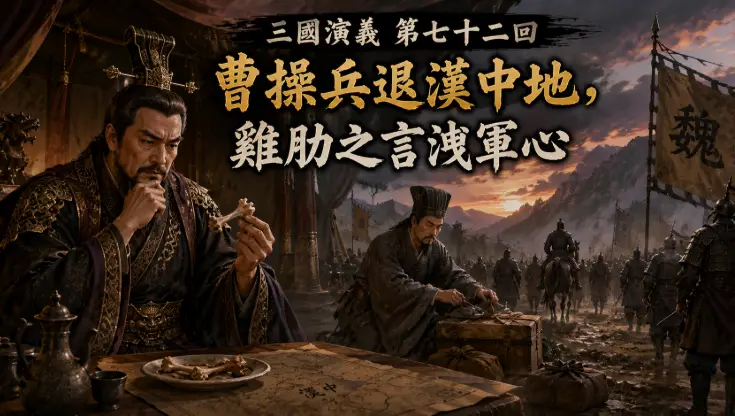
桌上放著一道雞肋。
曹操望著雞骨,不禁低聲說了一句:
「雞肋。」
聲音不大。
卻剛好被值夜官聽見。
軍令官依照慣例,將主帥當夜口令記錄下來。
很快,全軍都知道今晚口令只有兩個字——雞肋。
大多數士兵不明所以。
然而,楊修卻立刻命令隨從整理行裝。
旁人十分驚訝。
「尚未下令撤軍,為何收拾?」
楊修微微一笑。
「雞肋者,食之無味,棄之可惜。」
「漢中正如雞肋。」
「主公心中已有退意。」
眾人聽後恍然大悟。
消息很快傳入曹操耳中。
曹操臉色驟變。
並不是因為楊修猜錯。
恰恰相反。
正因為猜中了。
身為統帥,最忌軍心未動而機密先洩。
若人人皆能猜透主帥心思,軍令威嚴何在?
加上曹操早已不滿楊修屢次賣弄聰明。
如今終於找到理由。
最終,楊修被處死。
軍中一片沉默。
許多人惋惜他的才華。
也有人明白。
真正讓他送命的,不只是雞肋。
而是不懂收斂。
數日後。
曹操終於正式下令撤軍。
魏軍井然有序退出漢中。
遠方山巒依舊。
只是旗幟已漸漸遠去。
站在高處的劉備望著北方。
他知道。
自己終於奪得蜀漢最重要的一道天然屏障。
漢中,不只是勝利。
更是蜀漢立國最堅固的門戶。
而「雞肋」二字,也從此流傳千古。
成為人們形容食之無味、棄之可惜的經典典故。
English Version
The defeat at Mount Dingjun marked a turning point in the Hanzhong campaign.
For the first time in years, Cao Cao found himself trapped between ambition and reality.
Hanzhong had immense strategic value.
It protected the approaches into Shu while providing a gateway toward the fertile lands of Yi Province.
Abandoning it would weaken Wei’s western frontier.
Holding it, however, demanded enormous resources.
After Xiahou Yuan’s death, morale throughout the Wei army declined sharply.
Meanwhile, Liu Bei wisely avoided reckless attacks.
His forces occupied advantageous terrain and allowed pressure to build naturally.
Every passing day favored Shu.
Supply lines stretched across difficult mountain roads.
Transporting food and equipment became increasingly expensive and dangerous.
Inside Cao Cao’s headquarters, military advisers debated constantly.
Some argued for another major offensive.
Others believed preserving the army mattered more than preserving territory.
Cao Cao listened carefully.
He understood that neither choice offered a perfect outcome.
One evening, while eating supper, a simple chicken rib remained on the table.
Holding it briefly, Cao Cao quietly murmured,
“Chicken rib.”
The phrase was recorded as the night’s military password.
Soon, officers throughout the camp learned the unusual code.
Most dismissed it as meaningless.
One man did not.
Yang Xiu immediately instructed his attendants to begin packing.
When questioned, he calmly explained the hidden meaning.
“A chicken rib has little meat.”
“It is hardly worth eating.”
“Yet throwing it away still feels wasteful.”
“Hanzhong is exactly the same.”
“The Prime Minister has already decided to withdraw.”
His explanation spread rapidly.
Eventually, Cao Cao learned what Yang Xiu had concluded.
The problem was not that Yang Xiu had misunderstood.
The problem was that he had understood perfectly.
For a commander, intentions must remain hidden until the proper moment.
If subordinates openly interpreted every thought, authority itself would weaken.
Moreover, Yang Xiu had developed a reputation for displaying his intelligence too openly.
This incident merely confirmed long-standing concerns.
Cao Cao ordered his execution.
Many officers mourned the loss of a gifted scholar.
Others recognized a deeper lesson.
Exceptional intelligence without restraint can become a dangerous liability.
Several days later, Cao Cao officially announced the withdrawal from Hanzhong.
The retreat was conducted with discipline and order.
Across the mountains, Liu Bei watched the Wei banners disappear into the northern valleys.
He understood the importance of what had been achieved.
Hanzhong was not simply another captured territory.
It became the northern shield protecting Shu for years to come.
As for Cao Cao’s quiet remark over a simple meal, it survived far beyond the battlefield.
The expression “chicken rib” entered history as a timeless metaphor for something difficult to keep, yet equally difficult to abandon.