
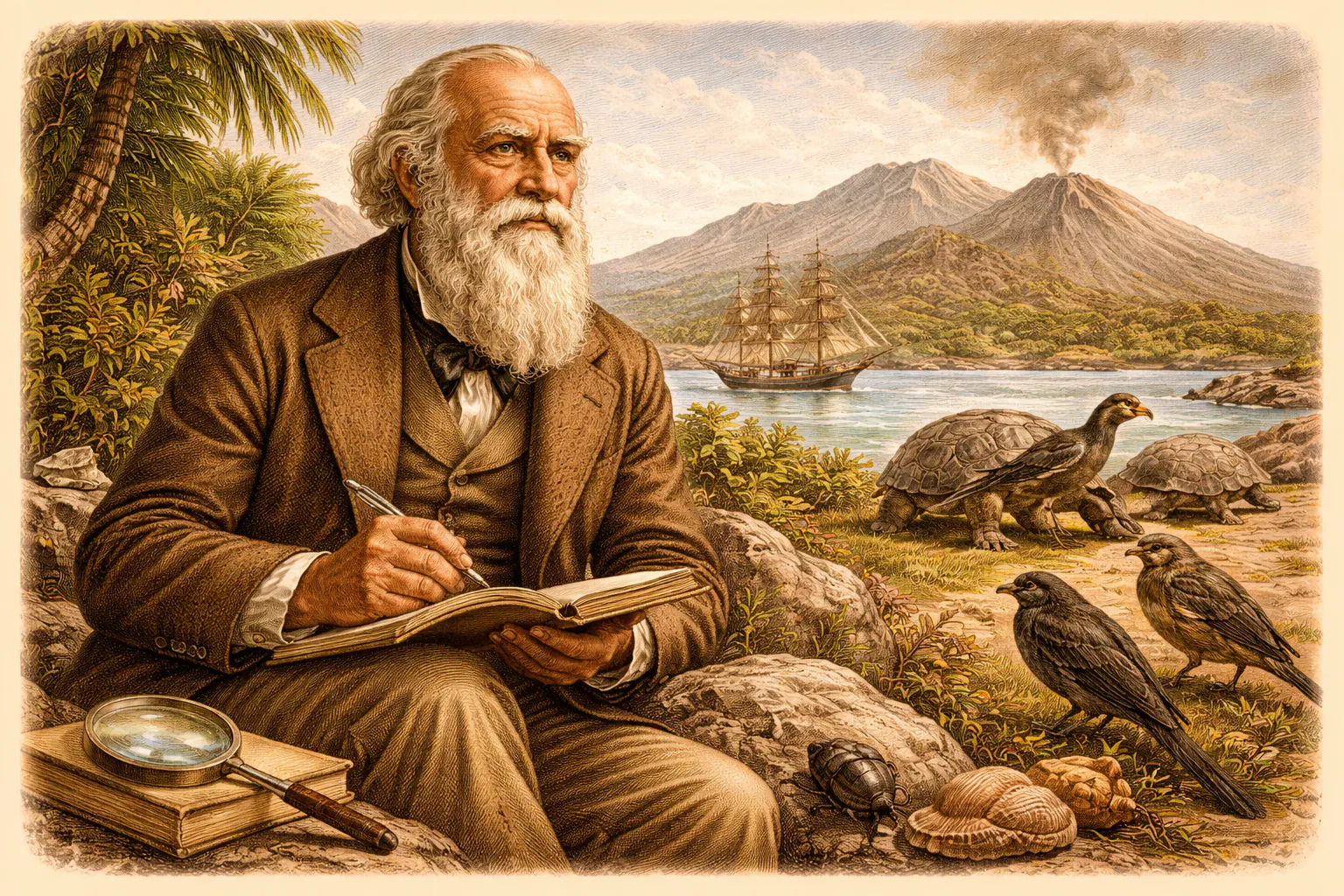
Charles Darwin|進化論的提出者:改變人類理解生命的科學家 | Charles Darwin | The Naturalist Who Revolutionized Biology with Evolution | 世界名人錄
查爾斯·達爾文(Charles Darwin)是19世紀最具影響力的科學家之一,也是現代生物學的重要奠基者。他提出的「自然選擇」理論,解釋了物種如何隨著時間演化,並在1859年出版《物種起源》一書,徹底改變人類對生命起源與生物多樣性的理解。達爾文透過長期觀察與研究,提出生物並非固定不變,而是會隨環境逐漸演化。這一思想不僅影響生物學,也深刻改變哲學、宗教與人類對自身位置的認知。
Charles Darwin (1809–1882) was an English naturalist whose theory of evolution by natural selection transformed the biological sciences. His landmark work, On the Origin of Species (1859), presented compelling evidence that species evolve over time through a process of variation and survival. Darwin’s observations during his voyage on the HMS Beagle, particularly in the Galápagos Islands, played a crucial role in shaping his ideas. His theory challenged traditional views of creation and reshaped scientific and philosophical thought. Today, Darwin is regarded as one of the most influential figures in science, and his work remains foundational to modern biology.
在人類科學史上,很少有理論像進化論那樣深刻地改變人類對生命的理解。查爾斯·達爾文正是提出這一理論的重要人物。他透過長期觀察、研究與思考,提出生物會隨著環境逐漸改變的觀點,從而建立自然選擇理論,為現代生物學奠定基礎。
達爾文於1809年出生於英國什魯斯伯里的一個醫生家庭。他的祖父伊拉斯謨·達爾文本身也是一位著名的自然學家,對自然界充滿興趣。這樣的家庭環境使達爾文從小便接觸到科學思想。
年輕時的達爾文並不是一名典型的優秀學生。他曾被父親送往愛丁堡大學學習醫學,但對外科手術感到厭惡,因此放棄了醫學道路。之後,他轉而進入劍橋大學學習神學,原本計畫成為一名牧師。
然而在劍橋期間,達爾文逐漸對自然史產生濃厚興趣。他經常收集昆蟲與植物標本,並與許多自然學家交流。正是在這段時間,他的科學興趣逐漸形成。
1831年,一個改變他人生的機會出現。英國皇家海軍的測量船「小獵犬號」準備展開一次環球航行,主要任務是測量南美洲海岸線。一位教授推薦達爾文以自然學家的身份加入這次航行。
這趟航行持續近五年,對達爾文的思想產生深遠影響。他在南美洲、加拉帕戈斯群島以及其他地區收集大量動植物與化石標本,並觀察不同地區生物之間的差異。
在加拉帕戈斯群島,達爾文注意到不同島嶼上的雀鳥具有不同形狀的喙,適應不同的食物來源。這一觀察使他開始思考:如果生物會隨環境改變,那麼物種可能並非固定不變。
回到英國後,達爾文花了二十多年時間整理資料並進行研究。他逐漸形成一個重要觀點:在自然界中,個體之間存在差異,而那些更適應環境的個體更容易存活並繁殖。這種過程會逐漸改變整個族群。
他將這一機制稱為「自然選擇」。簡單來說,自然環境會像篩選機制一樣,使適應性更強的個體留下後代,而不適應環境的個體則逐漸消失。
1859年,達爾文出版《物種起源》一書。這本書詳細闡述了自然選擇理論,並提供大量觀察與證據支持他的觀點。書中提出一個革命性的思想:所有生物可能源自共同祖先,並在漫長時間中逐漸演化。
這一理論在當時引起巨大震動。許多人認為它挑戰了傳統宗教對生命起源的解釋。然而也有許多科學家逐漸接受這一理論,因為它能夠解釋生物多樣性與化石記錄。
隨著時間推移,進化論逐漸成為生物學的核心理論。後來的遺傳學與分子生物學研究,也為自然選擇提供更多證據。
達爾文並不僅僅研究物種起源。他還撰寫多部著作,研究植物運動、蘭花授粉以及動物與人類情感表達。他對自然界的觀察極為細緻,顯示出深厚的科學精神。
1871年,他出版《人類的由來》,進一步討論人類進化問題。他提出人類與其他動物具有共同祖先的可能性,這一觀點在當時同樣引發廣泛討論。
儘管他的理論曾引起爭議,但達爾文本人性格溫和,並不熱衷於公開辯論。他更喜歡透過研究與寫作來表達觀點。
達爾文晚年生活在英國鄉村,持續進行研究與寫作。他在1882年去世,享年73歲。為了表彰他的科學貢獻,英國將他安葬在倫敦的西敏寺,與牛頓等偉大科學家並列。
回顧科學史,達爾文的理論不僅改變生物學,也影響哲學、人類學與社會思想。他讓人類第一次以科學方式理解生命的演化過程。
在現代生物學中,進化論已經成為理解生命的重要框架。從化石研究到基因分析,都不斷提供新的證據支持這一理論。
達爾文的最大貢獻,也許不只是提出一個理論,而是改變人類看待生命的方式。他讓人們意識到,人類並不是與自然界分離的存在,而是漫長演化歷程中的一部分。
正因如此,查爾斯·達爾文被視為歷史上最偉大的科學家之一。他的思想不僅改變科學,也改變了人類對自身與自然世界的理解。
English Version
Charles Darwin stands as one of the most influential figures in the history of science, a naturalist whose ideas fundamentally transformed our understanding of life on Earth. Born on February 12, 1809, in Shrewsbury, England, Darwin grew up in a well-educated and intellectually stimulating environment. His father was a physician, and his grandfather, Erasmus Darwin, had already expressed early ideas about evolution, which may have subtly influenced Charles’s later thinking.
Darwin initially pursued medical studies at the University of Edinburgh but found the practice of surgery distressing and unappealing. He later enrolled at the University of Cambridge with the intention of becoming a clergyman. However, his true passion lay in the study of nature. He developed a keen interest in geology, botany, and natural history, forming connections with influential scientists who would shape his intellectual development.
The defining moment in Darwin’s life came in 1831, when he embarked on a five-year voyage aboard the HMS Beagle as a naturalist. This journey took him to various parts of the world, including South America, Australia, and the Galápagos Islands. During the voyage, Darwin meticulously collected specimens and made detailed observations of plants, animals, and geological formations.
The Galápagos Islands proved particularly significant. Darwin noticed that closely related species, such as finches, varied slightly from island to island. These differences suggested that species were not fixed but could change over time in response to their environment. Although he did not immediately formulate his theory, these observations planted the seeds for his later work.
Upon returning to England, Darwin spent years analyzing his data and refining his ideas. Influenced by the work of Thomas Malthus on population growth, he realized that organisms produce more offspring than can survive. This leads to a struggle for existence, in which individuals with advantageous traits are more likely to survive and reproduce. Over generations, these traits become more common in the population. Darwin called this process “natural selection.”
In 1859, Darwin published his groundbreaking book, On the Origin of Species. In it, he presented extensive evidence supporting the theory of evolution by natural selection. The book challenged the prevailing belief that species were immutable and created independently. Instead, Darwin proposed that all life shares common ancestry and has diversified over time through gradual changes.
The publication of Darwin’s work sparked intense debate. While many scientists recognized the strength of his evidence, others, particularly within religious communities, resisted the implications of his theory. Despite the controversy, Darwin’s ideas gradually gained acceptance as further evidence accumulated from fields such as paleontology, genetics, and comparative anatomy.
Darwin continued his research throughout his life, publishing additional works on topics such as human evolution, sexual selection, and plant biology. His later book, The Descent of Man, extended his theory to human beings, suggesting that humans share a common ancestor with other animals. This idea was particularly controversial but has since become a cornerstone of modern biology.
Beyond his scientific contributions, Darwin was known for his careful and methodical approach to research. He spent decades gathering evidence, testing hypotheses, and refining his arguments before publishing his ideas. His commitment to empirical observation and logical reasoning set a high standard for scientific inquiry.
Darwin’s impact extends far beyond biology. His theory of evolution has influenced fields such as psychology, anthropology, and philosophy, shaping our understanding of human nature and our place in the natural world. It has also had profound cultural and intellectual implications, prompting reevaluations of long-held beliefs about life and existence.
Charles Darwin died on April 19, 1882, and was buried in Westminster Abbey, a testament to his significance in British and global history. Today, he is remembered as a pioneer who changed the way we think about life itself.
In many respects, Darwin did not merely propose a scientific theory—he introduced a new way of understanding the natural world. His concept of evolution by natural selection revealed the dynamic and interconnected nature of life, showing that all organisms are part of a vast, ongoing process of change.
Ultimately, Darwin’s legacy lies in his ability to uncover the underlying principles that govern the diversity of life. His work continues to inspire scientific discovery and remains a fundamental framework for understanding biology in the modern era.