
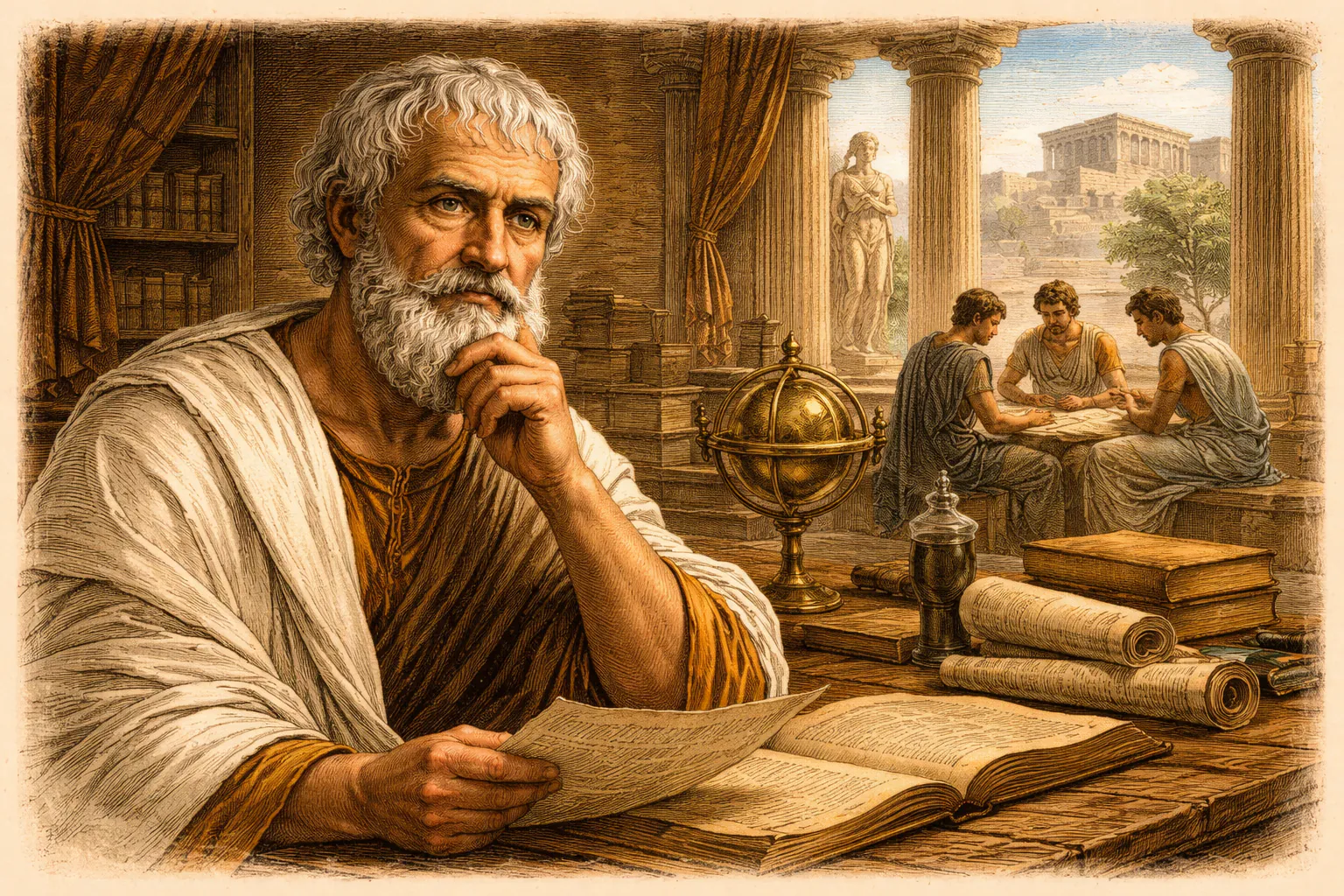
Aristotle|西方思想的奠基者:哲學、科學與邏輯的巨人 | Aristotle | The Philosopher Who Shaped Logic, Science, and Western Thought | 世界名人錄
亞里斯多德(Aristotle)是古希臘最重要的哲學家之一,也是西方思想史上影響最深遠的人物之一。他是柏拉圖的學生,同時也是亞歷山大大帝的老師。亞里斯多德的研究橫跨哲學、邏輯學、政治學、倫理學、生物學以及自然科學,建立了系統化的知識架構,對後世學術發展產生深遠影響。他創立的邏輯學與分類方法,長期成為西方學術研究的基礎。無論在哲學或科學史上,亞里斯多德都被視為奠定知識體系的重要思想家。
Aristotle (384–322 BCE) was one of the greatest philosophers in history and a foundational figure in Western thought. A student of Plato and teacher of Alexander the Great, he made groundbreaking contributions across a wide range of disciplines, including logic, metaphysics, ethics, politics, biology, and rhetoric. Aristotle established formal logic as a system of reasoning and emphasized empirical observation as a path to knowledge. His works influenced intellectual traditions for over two millennia, shaping philosophy, science, and education. His legacy remains central to understanding the development of rational inquiry and structured thought.
在人類思想史上,很少有人像亞里斯多德那樣對知識體系產生如此深遠的影響。他不僅是一位哲學家,更是一位對自然界充滿好奇的學者。他的研究涵蓋邏輯、倫理、政治、文學、物理、生物與形而上學等多個領域,為西方學術建立了長達兩千年的思想框架。
亞里斯多德於公元前384年出生於古希臘北部的斯塔吉拉。他的父親是一名宮廷醫師,服務於馬其頓王室。這樣的家庭背景使亞里斯多德從小便接觸醫學與自然觀察,也培養了他對生物與自然世界的興趣。
17歲時,亞里斯多德前往雅典,進入著名的柏拉圖學院學習。他在那裡學習與研究長達二十年,是柏拉圖最傑出的學生之一。柏拉圖的哲學強調理念世界,認為真正的真理存在於抽象的理念之中,而現實世界只是理念的影子。
然而亞里斯多德逐漸發展出不同的觀點。他認為哲學不應只停留在抽象思辨,而應該透過觀察與分析來理解現實世界。這種思想差異後來使他與柏拉圖的哲學方向逐漸分離。
柏拉圖去世後,亞里斯多德離開雅典,開始在不同地區進行研究與教學。他曾受邀成為馬其頓王子亞歷山大的老師。這位學生後來成為著名的亞歷山大大帝,建立橫跨歐亞非的大帝國。
在完成教育任務後,亞里斯多德回到雅典,創立了自己的學校——呂克昂學園。由於他經常一邊散步一邊講課,這個學派後來被稱為「逍遙學派」。在這裡,他與學生們進行大量研究與討論,形成一個早期的學術研究中心。
亞里斯多德最重要的貢獻之一,是建立系統化的邏輯學。他發展出「三段論法」,這是一種透過前提推導結論的推理方法。例如,如果所有人都會死亡,而蘇格拉底是人,那麼蘇格拉底也會死亡。這種邏輯結構成為西方哲學與科學推理的重要基礎,並在中世紀學術中占據核心地位。
在自然科學方面,亞里斯多德也做了大量觀察與記錄。他研究動物的分類、繁殖與行為,並撰寫多部關於生物學的著作。雖然其中一些結論後來被證明並不完全準確,但他的研究方法對後來的自然科學具有啟發性。
亞里斯多德也對物理世界提出自己的解釋。他認為世界由四種基本元素組成:土、水、空氣與火。每種元素都有其自然位置,例如土與水傾向向下,而火與空氣則向上。這種自然哲學在西方學術中影響長達兩千年,直到近代科學革命才逐漸被取代。
在倫理學方面,亞里斯多德提出著名的「中庸之道」。他認為美德是一種介於兩個極端之間的平衡。例如勇敢介於魯莽與懦弱之間,而慷慨則介於浪費與吝嗇之間。這種思想在他的著作《尼各馬可倫理學》中被詳細闡述。
亞里斯多德也深入研究政治制度。他在《政治學》中分析不同形式的政府,包括君主制、貴族制與民主制,並探討它們的優缺點。他認為理想的政治制度應該追求公共利益,而不是只服務少數人的利益。
在文學與藝術領域,亞里斯多德同樣留下重要思想。他在《詩學》中分析戲劇與悲劇的結構,提出「情感淨化」的概念,認為悲劇可以透過引發觀眾的憐憫與恐懼來達到心理淨化效果。這一理論對後來的文學批評與戲劇創作影響深遠。
亞里斯多德的思想在古代世界便已廣為流傳,但在中世紀時期,他的著作透過阿拉伯學者重新被介紹到歐洲,成為經院哲學的重要基礎。許多神學家嘗試將亞里斯多德的哲學與基督教思想結合,形成新的學術體系。
直到近代科學革命出現後,亞里斯多德的一些自然理論才逐漸被新的科學方法取代。然而,即使他的部分結論被修正,他建立的邏輯與哲學方法仍然對學術研究具有深遠影響。
亞里斯多德於公元前322年去世,但他的思想卻在後世持續發揮影響力。從古希臘哲學到中世紀神學,再到近代科學革命,許多思想家都曾與他的理論進行對話。
在整個西方思想史中,亞里斯多德不僅是一位哲學家,更是一位建立知識體系的學者。他將觀察、分類與邏輯推理結合起來,使知識能夠被系統地整理與傳承。
正因如此,亞里斯多德常被視為人類歷史上最偉大的思想家之一。他所建立的知識框架,不僅塑造了古代與中世紀的學術世界,也為後來的科學與哲學發展奠定重要基礎。
English Version
Aristotle stands as one of the most influential thinkers in human history, a philosopher whose work laid the intellectual foundations for a vast range of disciplines, from logic and metaphysics to biology and political theory. Born in 384 BCE in Stagira, a small city in northern Greece, Aristotle entered a world already shaped by the philosophical legacy of his predecessors. His father, Nicomachus, served as a physician to the Macedonian court, which may have contributed to Aristotle’s early interest in the natural sciences.
At the age of seventeen, Aristotle traveled to Athens to study at Plato’s Academy, the most prestigious center of learning in the Greek world. He remained there for nearly twenty years, absorbing and engaging with Platonic philosophy. While he deeply respected his teacher, Aristotle eventually developed ideas that diverged significantly from Plato’s emphasis on abstract forms. Instead, Aristotle placed greater importance on empirical observation and the study of the natural world.
After leaving the Academy, Aristotle spent time traveling and conducting research before being invited to tutor the young Alexander, who would later become known as Alexander the Great. This relationship highlights Aristotle’s influence not only on philosophy but also on historical events, as his teachings may have shaped the worldview of one of history’s most powerful rulers.
Later, Aristotle returned to Athens and founded his own school, the Lyceum. Unlike the Academy, which focused more on abstract philosophical inquiry, the Lyceum emphasized systematic research and the collection of knowledge. Aristotle and his students conducted studies in a wide range of fields, including biology, physics, ethics, politics, and rhetoric. This interdisciplinary approach reflects Aristotle’s belief that knowledge is interconnected and that understanding the world requires examining it from multiple perspectives.
One of Aristotle’s most enduring contributions is his development of formal logic. He introduced the system of syllogistic reasoning, a method of argument in which conclusions are drawn from premises through structured inference. This system became the foundation of logical thought for centuries and remains influential in modern philosophy and mathematics.
In metaphysics, Aristotle explored questions about existence, substance, and causality. He introduced the concept of the “four causes” (material, formal, efficient, and final) as a way of explaining why things exist and how they change. This framework provided a comprehensive approach to understanding reality, integrating both physical and philosophical perspectives.
Aristotle’s work in ethics, particularly in his Nicomachean Ethics, centers on the idea of virtue and the pursuit of a good life. He argued that happiness (eudaimonia) is the ultimate goal of human existence and is achieved through the cultivation of virtue and the exercise of reason. His concept of the “golden mean”—the idea that virtue lies between extremes—remains a key principle in ethical philosophy.
In politics, Aristotle analyzed different forms of government and their strengths and weaknesses. He viewed humans as “political animals,” naturally inclined to live in communities. His work Politics examines the organization of the state and the role of citizens, emphasizing the importance of balance and stability in governance.
Aristotle also made significant contributions to the natural sciences. In biology, he conducted detailed observations of animals and classified them based on their characteristics. Although some of his conclusions were later revised, his emphasis on empirical observation marked an important step in the development of scientific methodology.
Despite his immense influence, Aristotle’s work was not without limitations. Some of his scientific ideas were later proven incorrect, particularly in physics. However, his methodological approach—combining observation with logical analysis—remains a cornerstone of intellectual inquiry.
After the death of Alexander the Great, political tensions in Athens led Aristotle to leave the city. He spent his final years in Chalcis, where he died in 322 BCE. Despite the challenges he faced, his intellectual legacy endured and continued to shape thought across cultures and centuries.
During the Middle Ages, Aristotle’s works were preserved and studied by Islamic scholars and later reintroduced to Europe, where they became central to scholastic philosophy. Thinkers such as Thomas Aquinas integrated Aristotelian philosophy with Christian theology, further extending his influence.
Today, Aristotle is remembered not only as a philosopher but as a pioneer of systematic thinking. His work established frameworks that continue to guide disciplines ranging from science to ethics and politics. His emphasis on reason, observation, and structured analysis has left an enduring mark on human knowledge.
In many ways, Aristotle’s greatest achievement was his ability to organize and synthesize knowledge into coherent systems. He sought to understand the world in its entirety, bridging the gap between abstract thought and empirical reality. This holistic vision remains one of his most powerful contributions.
Ultimately, Aristotle’s legacy lies in his commitment to understanding the principles that govern both nature and human life. His work continues to inspire inquiry, debate, and discovery, making him one of the central figures in the intellectual history of humanity.