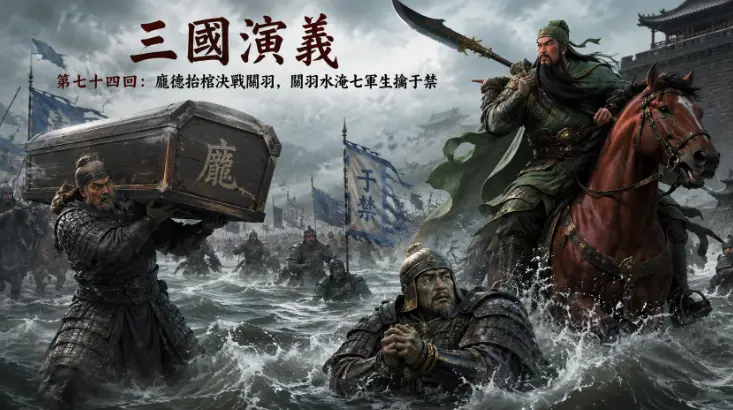
關羽北伐樊城,曹操急派于禁率七軍南下救援,龐德更抬棺出征,誓與關羽決一死戰。就在雙方激戰難分之際,漢水暴漲,關羽順勢放水淹沒七軍,生擒于禁、斬殺龐德,一戰震動天下,「威震華夏」之名自此傳遍四方。
As Guan Yu pressed his campaign against Fancheng, Cao Cao dispatched Yu Jin and seven armies to relieve the siege, while Pang De marched into battle carrying his own coffin as a symbol of absolute determination. A sudden flood transformed the battlefield, allowing Guan Yu to destroy Wei’s forces in one of the most legendary victories in Chinese literature, forever establishing his reputation across the empire.
中文
襄樊前線,戰雲密布。
關羽率領荊州大軍,兵臨樊城,日夜攻打。守將曹仁據城死守,城內糧草日益短缺,卻始終不敢輕易出戰。
遠在許都的曹操接到急報,知道若樊城失守,中原門戶將被打開,立刻命于禁統率七軍南下,又命勇將龐德同行,共赴前線。
龐德本是西涼名將,昔日追隨馬超,後來歸附曹操。他深知關羽天下無雙,因此出征前命人抬著棺木同行。
眾將見狀無不震驚。
龐德神色平靜,只說一句話:
「若不能斬關羽,便以此棺收我。」
消息傳遍軍中,魏軍士氣頓時大振。
不久,兩軍於樊城外展開激戰。
關羽騎赤兔馬,手提青龍偃月刀,如天神下凡,衝鋒陷陣,勢不可擋。
龐德毫不畏懼,挺刀迎戰。
刀光交錯,戰馬奔騰,二人連戰數十回合,不分高下。
龐德越戰越勇,更趁關羽稍有破綻,一箭射中其左臂。
蜀軍將士驚呼失色,紛紛勸關羽退軍療傷。
關羽卻只是命軍醫包紮傷口,重新跨上戰馬。
「區區箭傷,豈能阻我?」
一句話,再度激起全軍鬥志。
然而,真正改變戰局的,不是兵器,而是天意。
連日豪雨,漢水暴漲。
滾滾洪流沖刷河岸,天地之間盡是雷鳴雨勢。
關羽登高觀察地勢,發現魏軍七營皆建於低窪之處,若善加利用洪水,便能一舉擊潰敵軍。
他立即下令掘開堤壩,引漢水直衝敵營。
頃刻之間,洪水如萬馬奔騰。
魏軍營寨瞬間被洪流吞沒,戰馬翻倒,軍旗折斷,無數士兵在激流中掙扎求生。
七軍大亂。
于禁眼見大勢已去,只能率殘兵登高避水。
然而四周早已被蜀軍包圍。
最終,于禁放下兵器,向關羽投降。
這位曹魏名將,自此成為關羽最著名的俘虜。
另一邊,龐德雖落入蜀軍之手,卻始終昂首而立。
關羽親自勸降。
「將軍勇烈,若願歸漢,必受重用。」
龐德怒視關羽。
「我受魏王厚恩,豈可貪生忘義!」
即使刀架頸前,他依舊毫無懼色。
最終,關羽命人將其斬首。
這位抬棺出征的猛將,以生命完成自己的誓言,也贏得敵我雙方敬重。
捷報飛傳四方。
「關羽水淹七軍,生擒于禁!」
天下震動。
曹操聞訊,久久無語。
群臣皆言:「關羽威勢太盛。」
甚至有人建議遷都,以避其鋒。
雖然最終未曾實行,但足見關羽此戰帶來的巨大震撼。
各地豪傑聞風而動,不少郡縣望風歸附。
「威震華夏」四字,自此成為關羽最耀眼的稱號。
然而,勝利越大,危機也越深。
荊州兵力因長期北伐而日漸空虛,糧道漫長,後方防備逐漸鬆動。
東吳孫權表面仍與蜀漢維持盟約,實際上卻密切關注戰局。
一場足以改變天下格局的陰謀,正悄然展開。
而站在勝利巔峰的關羽,仍未察覺,一場比樊城之戰更加殘酷的命運,正在前方等待著他。
English Version
The siege of Fancheng had reached a critical stage.
Guan Yu’s army surrounded the fortress with relentless determination, while Cao Ren struggled to defend the city despite dwindling supplies. Every passing day increased the pressure on Wei’s defenses.
Recognizing the danger, Cao Cao ordered Yu Jin to lead seven armies south to rescue the fortress. Accompanying him was Pang De, a fearless warrior whose reputation matched his unwavering courage.
Before leaving, Pang De shocked everyone by having a coffin carried alongside his troops.
His message was unmistakable.
“If I cannot defeat Guan Yu, this coffin shall carry me home.”
The gesture inspired Wei’s soldiers, who marched with renewed determination.
Soon the armies clashed outside Fancheng.
Mounted on the legendary Red Hare and wielding the Green Dragon Crescent Blade, Guan Yu charged through the battlefield like an unstoppable force. Pang De refused to retreat, matching every strike with equal bravery.
Their duel became one of the most celebrated encounters of the era.
During one fierce exchange, Pang De fired an arrow that struck Guan Yu’s left arm. Many feared the injury would force the Shu commander to withdraw.
Instead, Guan Yu simply had the wound bandaged and returned immediately to battle, refusing to show weakness before his soldiers.
Nature, however, was preparing the decisive blow.
Days of relentless rain caused the Han River to overflow beyond its banks. Guan Yu carefully studied the terrain and realized the Wei camps had been established on vulnerable low ground.
He seized the opportunity.
Engineers opened the flood barriers, releasing an enormous torrent toward the enemy encampments.
Within moments, roaring waters swept through the seven armies.
Tents collapsed, horses disappeared beneath the flood, and disciplined formations dissolved into complete chaos. Soldiers struggled desperately against the current as commands vanished beneath the thunder of rushing water.
Yu Jin recognized that resistance had become impossible.
Surrounded by Guan Yu’s forces after escaping the flood, he surrendered to save the lives of his remaining troops.
Pang De chose a different path.
Captured after fighting to the very end, he refused every offer to change sides. Guan Yu admired his courage and offered him a respected position within Shu.
Pang De rejected the proposal without hesitation.
He declared that loyalty was worth more than life itself.
Respecting his resolve but unwilling to leave a dangerous enemy alive, Guan Yu ordered his execution.
News of the victory spread with astonishing speed.
“Guan Yu has flooded seven armies and captured Yu Jin.”
The announcement stunned the entire empire.
Even Cao Cao reportedly considered moving his capital before advisers persuaded him to remain. Throughout northern China, Guan Yu’s reputation reached unprecedented heights, while officials and military leaders openly discussed his extraordinary achievements.
It was after this campaign that history remembered Guan Yu as the warrior whose power “shook all under Heaven.”
Yet behind the glory lay hidden dangers.
Shu’s forces had advanced far from their base, stretching supply lines across dangerous territory. Jing Province was left increasingly vulnerable, while Sun Quan quietly watched every development from the east.
Unknown to Guan Yu, political calculations had already begun to outweigh military victories.
The flood that destroyed Wei’s seven armies became one of the greatest triumphs in the Romance of the Three Kingdoms—but it also marked the beginning of the final chapter of Guan Yu’s remarkable career.