
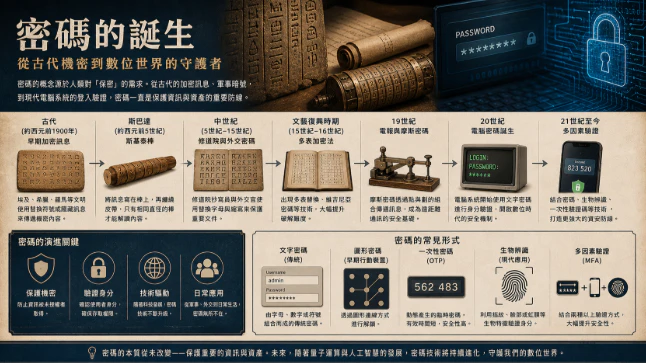
密碼看似簡單,卻是人類保護資訊與身份的重要工具。從古代軍事暗號到現代網絡登入系統,密碼的演變反映了安全需求與科技進步的交織,成為數位時代不可或缺的防線。
Passwords may appear simple, yet they serve as a fundamental layer of protection for information and identity. From ancient secret codes to modern login systems, their evolution mirrors the growing need for security in an increasingly connected world.
中文
密碼的起源可以追溯至人類最早對「保密」的需求,在古代社會中,人們已經開始使用暗號與符號來保護重要資訊,例如軍事命令與外交通信,這些早期形式雖然簡單,但已具備密碼的基本概念,即只有特定人員才能理解與使用,隨著文明發展,加密方式逐漸複雜,從簡單替換字母到更精細的編碼系統,密碼開始成為權力與知識的象徵,到了近代,隨著電報與通信技術的出現,資訊傳遞速度大幅提升,同時也帶來更高的安全需求,密碼因此進一步發展為系統化的加密方法,而真正讓「密碼」進入日常生活的,是電腦時代的來臨,20世紀中期,電腦系統開始需要區分不同使用者的權限,於是引入登入密碼的概念,每位使用者需透過一組獨特字串來驗證身份,這種方式迅速成為資訊安全的標準,隨著網際網路普及,密碼的重要性急劇提升,不僅用於電腦登入,更延伸至電子郵件、銀行系統與各類線上服務,成為數位身份的核心之一,然而,隨著駭客技術與網絡攻擊日益進步,單一密碼逐漸顯得不足,促使多重驗證與生物識別技術的出現,例如指紋與臉部辨識,這些技術並未取代密碼,而是與其結合形成更強大的安全機制,密碼的本質也從單純的「秘密字串」演變為複合型身份驗證的一部分,在今日的數位世界中,密碼不僅保護個人資料,也維繫整個網絡系統的穩定運作,從古代暗號到現代加密技術,密碼的演變反映出人類對安全與信任的不斷追求,它不只是一組字符,而是一道看不見的防線,守護著資訊時代的每一個連結
English Version:
The concept of passwords originates from humanity’s earliest need for secrecy and controlled access to information. In ancient societies, simple codes and signals were used to safeguard military orders and diplomatic messages, allowing only authorized individuals to understand their meaning. As civilizations advanced, encryption methods became more sophisticated, evolving from basic letter substitutions to more complex encoding systems. Over time, secrecy became closely tied to power and knowledge. With the emergence of telecommunication technologies such as the telegraph, the speed of information exchange increased dramatically, bringing new challenges in maintaining security. This led to more structured approaches to encryption and authentication. The true transformation of passwords into a daily necessity came with the rise of computing in the mid-twentieth century, when computer systems required a way to distinguish between users and control access. Passwords were introduced as unique strings assigned to individuals, forming the basis of digital authentication. As the internet expanded, passwords became central to nearly every aspect of online interaction, from email accounts to financial systems and social platforms. However, as cyber threats grew more sophisticated, relying on a single password proved insufficient. This gave rise to enhanced security measures such as multi-factor authentication and biometric verification, including fingerprints and facial recognition. Rather than replacing passwords, these technologies complement them, creating layered security systems. Today, passwords are deeply embedded in the digital ecosystem, protecting personal data and ensuring the integrity of global networks. From ancient secret codes to advanced cybersecurity frameworks, the evolution of passwords reflects an ongoing pursuit of trust, privacy, and protection in an interconnected world.